
Examine the role of religion in Indian electoral politics in the contemporary times.
How the answer moves
The flow snapshot — the routes in, the body, the counter-view and the routes out.
Route 1 law bars religious appeals (RPA §123(3) + SC 2017) → yet religion stays a strong emotive factor in voting
Route 2 religion formally out of the ballot → in practice it works as “identity plus,” not alone
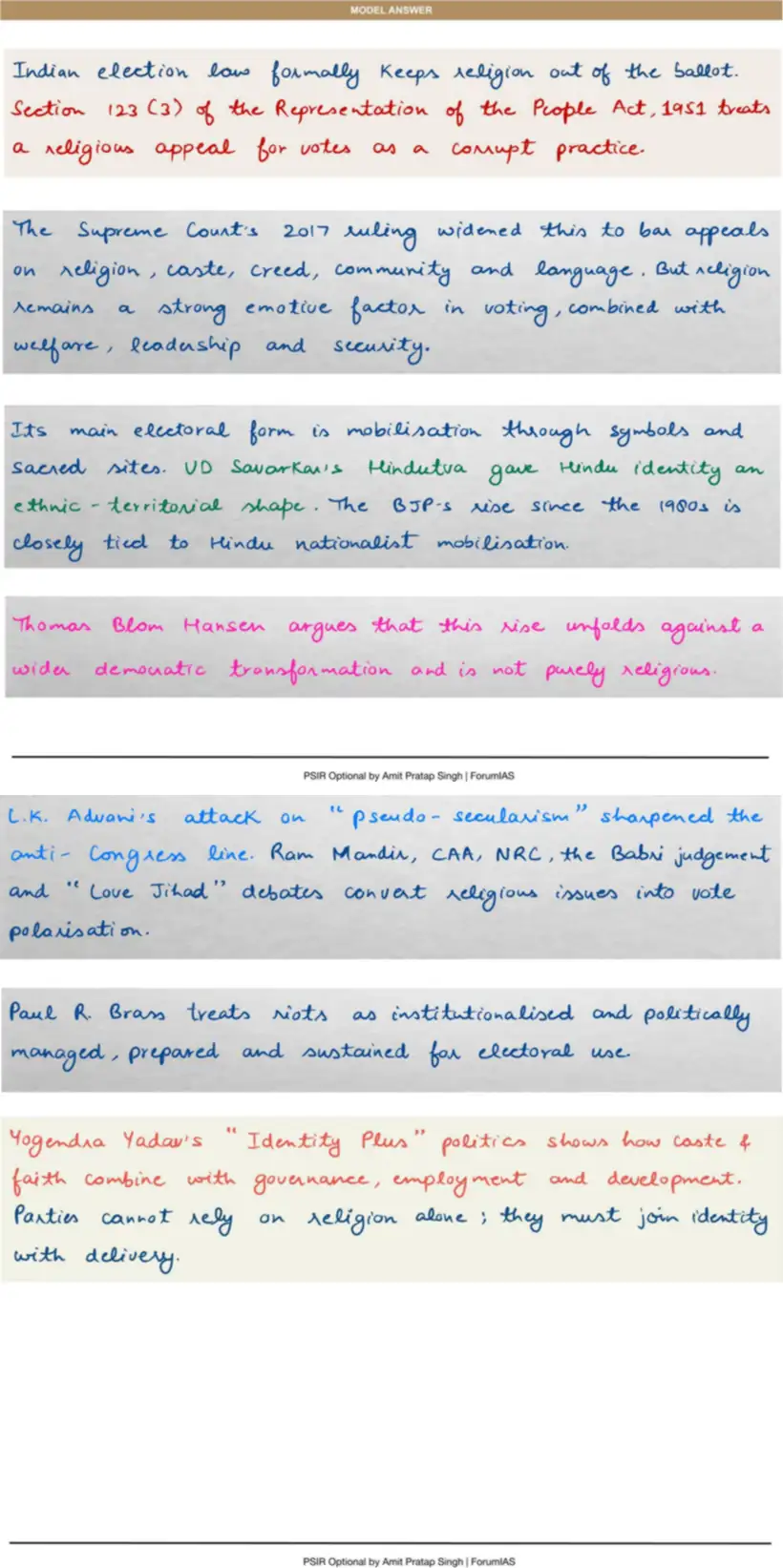
mobilisation via symbols / sacred sites → Savarkar’s Hindutva (ethnic-territorial Hindu identity) → BJP’s rise since the 1980s tied to Hindu nationalist mobilisation → Hansen: set against democratic transformation, not purely religious → Advani’s “pseudo-secularism” → anti-Congress line → Ram Mandir / CAA / NRC / Babri / “Love Jihad” → vote polarisation + minority consolidation → Brass: institutionalised riots prepared & used electorally
religion no longer works alone → Yadav’s “Identity Plus” → faith combines with governance, employment, development → identity must pair with delivery
Route 1 religion is strong but not sufficient → parties must join identity with governance and delivery
Route 2 shift from religion-alone to “identity plus” → contemporary parties combine faith with development and security
Model answer
Handwritten, in the form it would be written in the examination hall.
Also asked on this head
Caste, Religion and Ethnicity in Indian Politics — 12 questions in the Vault.
- Map the different types of ethnic conflicts that have emerged in 21st century India.
- Identity has become an important phenomenon in the modern politics in India. Discuss. (150 words)
- Caste remains a vital axis for political mobilisation in India. How would the caste census address the aspirations of people? Discuss.
How this is taught
The same flow snapshot, built for every head of the syllabus, with the answer written in class.
The first session of Foundation 2027 is published in full.
Six programmes across three levels.