
Explain how caste as a social category is also becoming a political category in the democratic politics of India.
How the answer moves
The flow snapshot — the routes in, the body, the counter-view and the routes out.
Route 1 caste as social institution (birth, ritual rank, hierarchy) → democracy changes its function → it becomes a category of political bargaining
Route 2 Kothari’s frame → democracy works through society, not outside it → politics reshapes caste
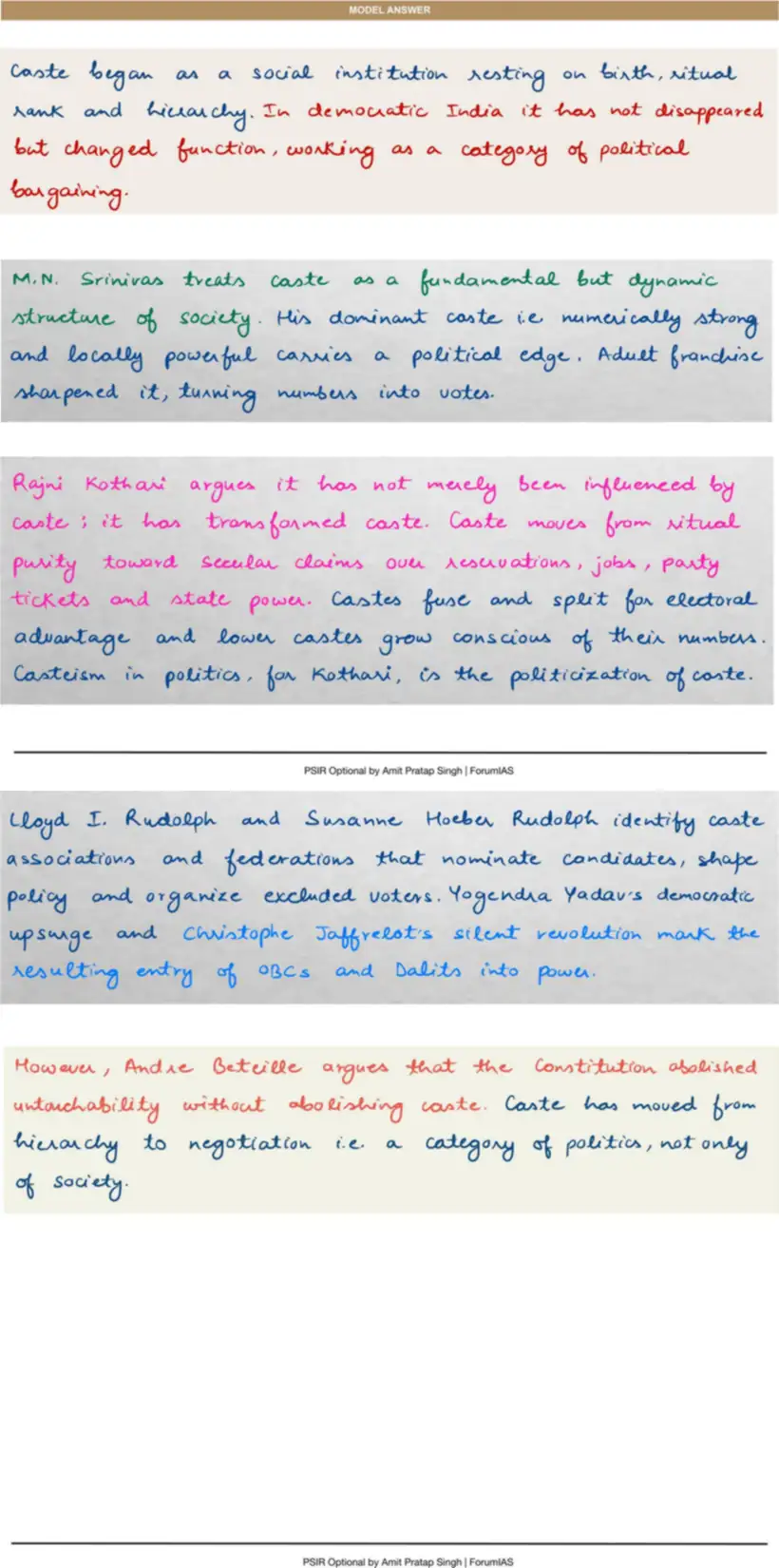
Srinivas: caste dynamic, not frozen → the dominant caste is already political → adult franchise turns numbers into votes → Kothari: secularisation (ritual purity → reservations, jobs, tickets, power) + integration (castes fuse and split) + secular consciousness (aware of numbers) → politicisation of caste → Rudolphs: caste associations & federations as vehicle (candidates, policy, excluded voters) = modernisation of tradition → caste-based parties institutionalise → Yadav’s democratic upsurge + Jaffrelot’s silent revolution → OBCs and Dalits enter power
Béteille: untouchability abolished, caste not → caste survives in public policy → politicisation cuts both ways
Route 1 caste from hierarchy to negotiation → a category of politics, not only of society
Route 2 a “democracy of castes” → representation widened, but justice needs more than caste arithmetic
Model answer
Handwritten, in the form it would be written in the examination hall.
Also asked on this head
Caste, Religion and Ethnicity in Indian Politics — 12 questions in the Vault.
- Map the different types of ethnic conflicts that have emerged in 21st century India.
- Identity has become an important phenomenon in the modern politics in India. Discuss. (150 words)
- Caste remains a vital axis for political mobilisation in India. How would the caste census address the aspirations of people? Discuss.
How this is taught
The same flow snapshot, built for every head of the syllabus, with the answer written in class.
The first session of Foundation 2027 is published in full.
Six programmes across three levels.