
Delineate the key factors that have shaped the evolving political landscape in Jammu and Kashmir post 2019.
How the answer moves
The flow snapshot — the routes in, the body, the counter-view and the routes out.
Route 1 Aug 5, 2019 abrogation as the pivot → special-status autonomy replaced by integration with the Union
Route 2 post-2019 landscape reset → every later factor flows from one constitutional change
Article 370 + 35A removed → J&K–Union legal relation altered → bifurcation into two UTs → centralisation + political reorganisation → NC & PDP lose the autonomy plank → demand restoration of voice → Balraj Puri: autonomy erosion / democratic breakdown → representation stays live → security restrictions + civil-rights debate → Centre’s integration via development / investment (tourism, handicrafts, agriculture, IT)
central integration + development claim vs the regional demand for restored voice → ethnic / religious / regional identities + Pakistan-backed militancy persist
Route 1 integration must be matched by restored representation → stability rests on dialogue + confidence-building
Route 2 the landscape is still evolving, not settled → its direction depends on political voice, not security alone
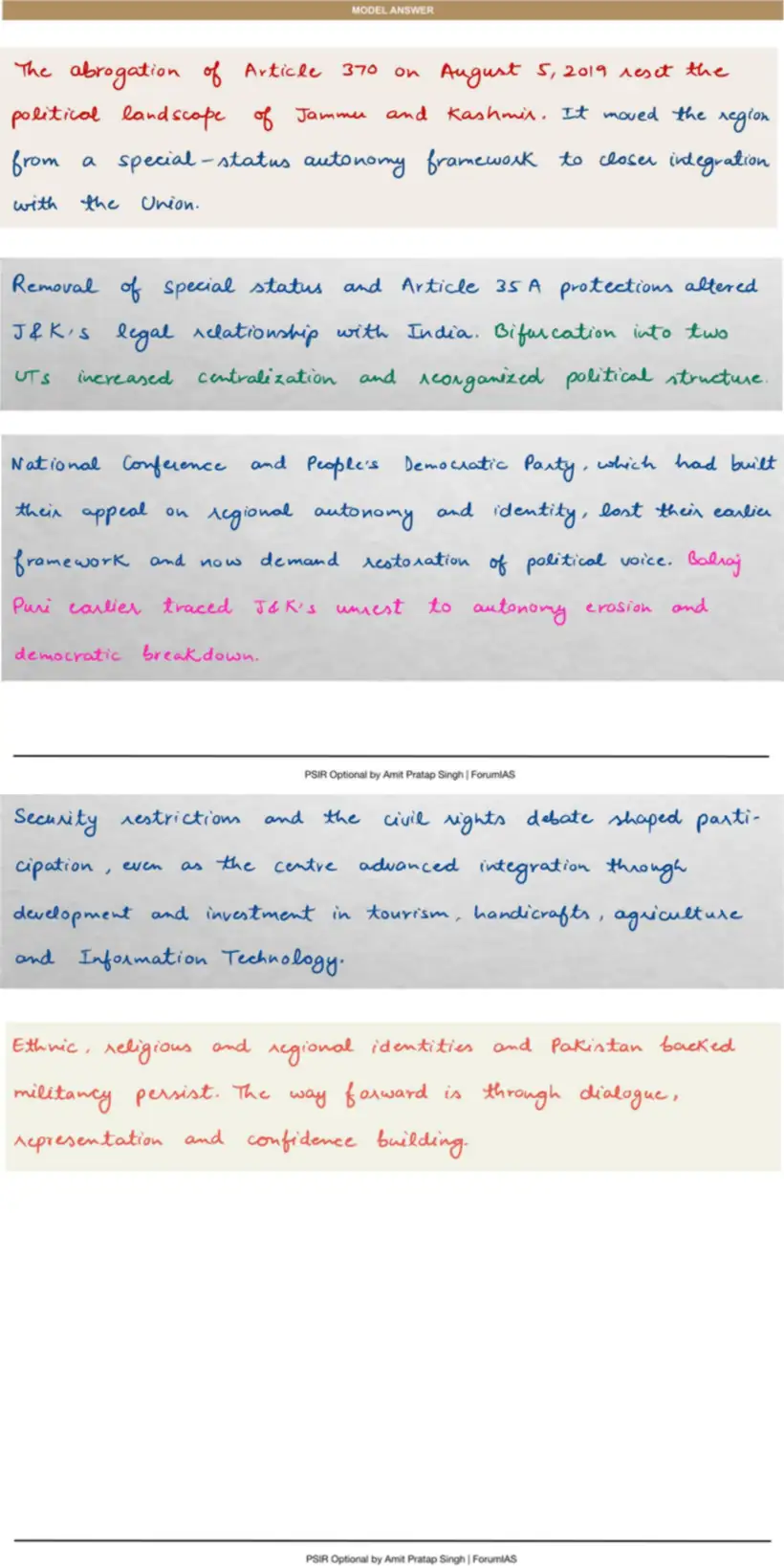
Model answer
Handwritten, in the form it would be written in the examination hall.
Also asked on this head
Caste, Religion and Ethnicity in Indian Politics — 12 questions in the Vault.
- Map the different types of ethnic conflicts that have emerged in 21st century India.
- Identity has become an important phenomenon in the modern politics in India. Discuss. (150 words)
- Caste remains a vital axis for political mobilisation in India. How would the caste census address the aspirations of people? Discuss.
How this is taught
The same flow snapshot, built for every head of the syllabus, with the answer written in class.
The first session of Foundation 2027 is published in full.
Six programmes across three levels.