
Critically examine the impact of Globalisation on the developing countries of the world.
How the answer moves
The flow snapshot — the routes in, the body, the counter-view and the routes out.
Route 1 globalisation reshapes developing world (economic/social/cultural) → record two-sided → opportunity bundled with dependency + inequality
Route 2 verdict neither rejection nor celebration → stake the line: the case is for reform
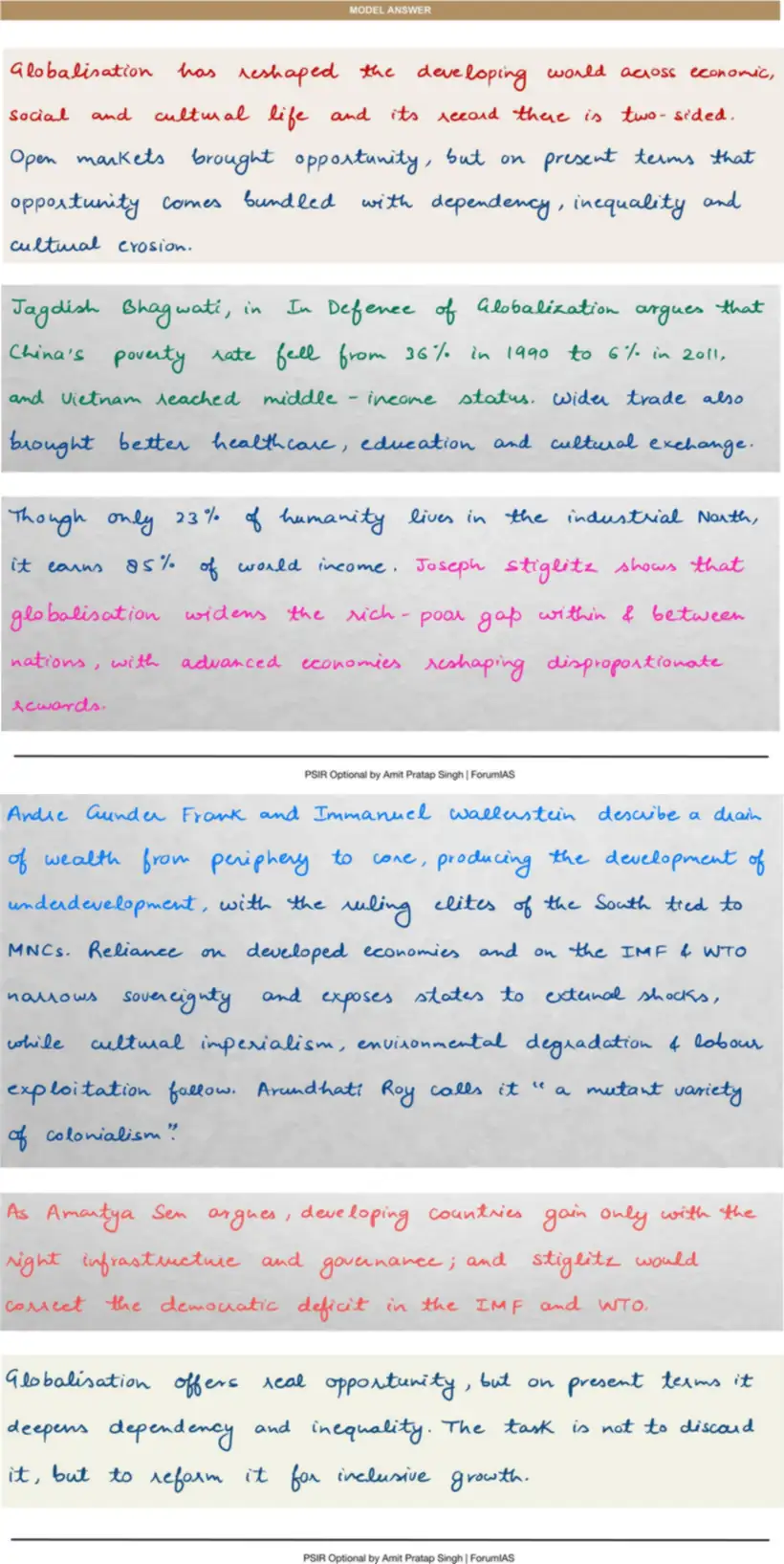
gains real: markets opened, exports + FDI up, growth (China, India), tech transfer → Bhagwati (In Defence of Globalization): tool against poverty → China 36% → 6%, Vietnam middle-income → social gains (health, education, exchange) → but gains unevenly captured → North = 23% of people, 85% of income → Stiglitz: rich–poor gap widens, advanced nations reap disproportionate rewards → dependency school (Frank, Wallerstein): drain periphery → core = development of underdevelopment; Southern elites tied to MNCs → IMF/WTO reliance narrows sovereignty, invites external shocks → cultural imperialism + environmental degradation + labour exploitation → Roy: “mutant variety of colonialism”
against dependency pessimism → benefits real but conditional → Sen: gains need infrastructure + governance → Stiglitz: fix democratic deficit in IMF/WTO
Route 1 opportunity real, but present terms deepen dependency + inequality → reform, not rejection, for inclusive growth
Route 2 double-edged process → the need is the right balance of openness and regulation
Model answer
Handwritten, in the form it would be written in the examination hall.
Also asked on this head
Globalisation — 10 questions in the Vault.
- Global South-sensitive model of globalization would prevent the danger emanating from overcentralized clobalization. Discuss.
- “Deglobalisation is displacing globalisation.” Comment.
- What are the main challenges faced by the developing countries in the era of globalisation?
How this is taught
The same flow snapshot, built for every head of the syllabus, with the answer written in class.
The first session of Foundation 2027 is published in full.
Six programmes across three levels.