
What is globalisation? Why is there an intense debate about globalisation and its consequences?
How the answer moves
The flow snapshot — the routes in, the body, the counter-view and the routes out.
Route 1 define via Giddens → intensification of worldwide social relations / time–space compression → theme is interdependence
Route 2 globalisation = overlapping, contradictory processes → resists a single definition → the contest starts with “what it even is”
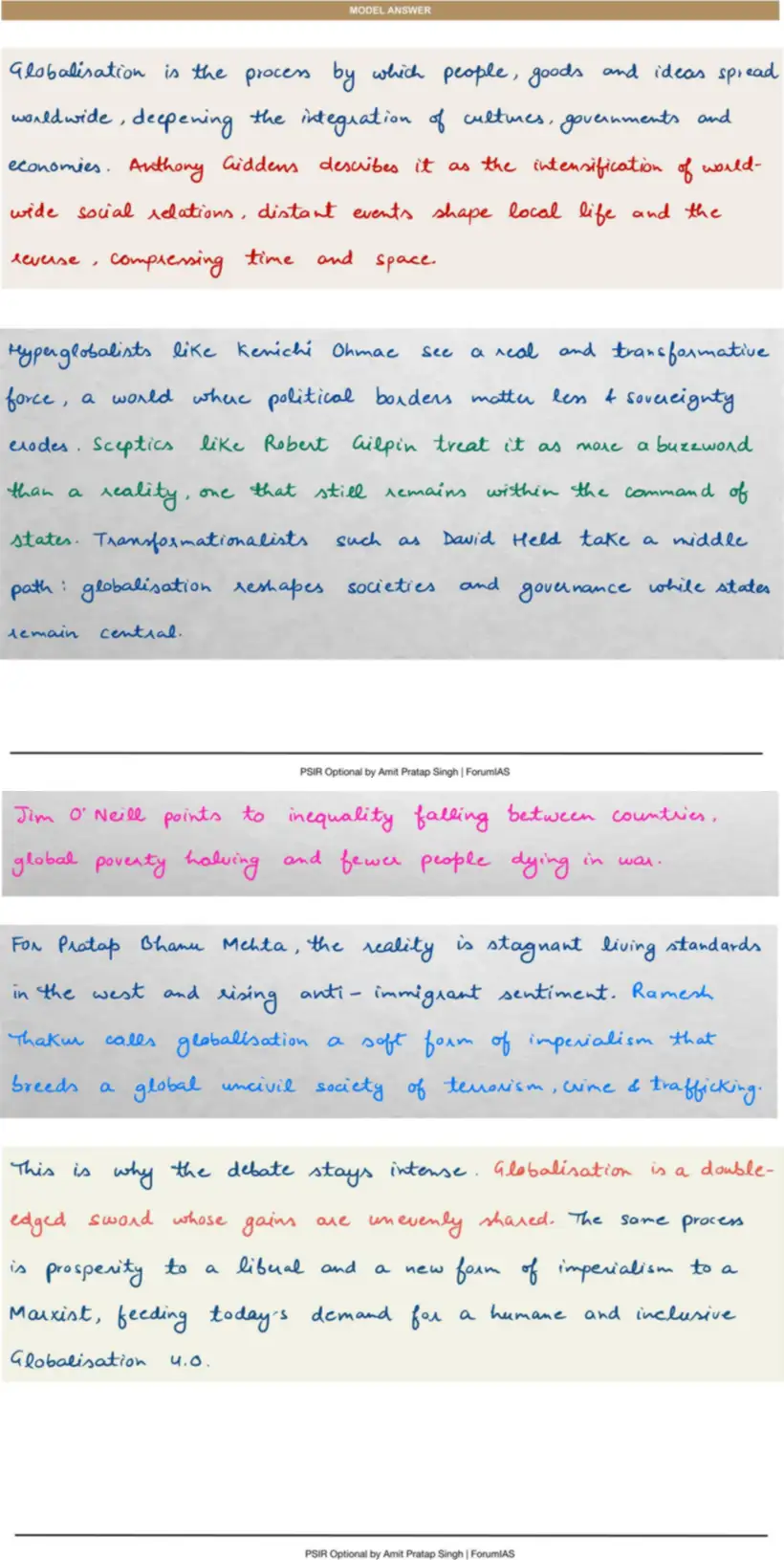
definition (integration + interdependence) → disagreement over the state → Ohmae (real, borders/sovereignty erode) → Gilpin (buzzword, states in command) → Held (reshapes, states remain) → shift to consequences → O’Neill gains (inequality down, poverty halved, fewer battle deaths) → Mehta (Western stagnation, xenophobia) → Thakur (soft imperialism, uncivil society)
liberal optimism (O’Neill’s gains) set against the Marxist–postcolonial charge of neo-imperialism and the dark side (Thakur) — one process, opposite readings
Route 1 intense because it is a double-edged sword with unevenly shared gains → contested across rival lenses
Route 2 prosperity for the liberal, new imperialism for the Marxist → hence the call for a humane, inclusive Globalisation 4.0
Model answer
Handwritten, in the form it would be written in the examination hall.
Also asked on this head
Globalisation — 10 questions in the Vault.
- Global South-sensitive model of globalization would prevent the danger emanating from overcentralized clobalization. Discuss.
- “Deglobalisation is displacing globalisation.” Comment.
- Critically examine the impact of Globalisation on the developing countries of the world.
How this is taught
The same flow snapshot, built for every head of the syllabus, with the answer written in class.
The first session of Foundation 2027 is published in full.
Six programmes across three levels.