
How has the development of Global Capitalism changed the nature of socialist economies and developing societies?
How the answer moves
The flow snapshot — the routes in, the body, the counter-view and the routes out.
Route 1 global capitalism beyond borders (transnational capital / class / state) → Soviet collapse removes the socialist alternative → spreads via neo-liberal Washington Consensus
Route 2 end of Cold War = triumph of capitalism over socialism → one market model now imposed on socialist + developing economies alike
Neo-Gramscian hegemony of market fundamentalism (1980s–2008) → IMF Structural Adjustment (reduced govt, liberalisation, privatisation) → debt-hit socialist + developing states open markets → socialist de jure, de facto mixed (East Europe) → developing societies liberalise/privatise (India’s LPG) → East Asian crisis 1997 dents IMF, but growth + falling poverty sustain commitment → 2000s power shift → 2007 IMF/World Bank voting favours developing countries → India & China rise within the same system
Wallerstein: transnational division of labour keeps developing countries subordinate; states cannot regulate MNCs or sustain welfare → 2008 crisis confirms → Ngaire Woods: states vs markets, who really benefits
Route 1 West retreats to protectionism while developing countries defend free trade → capitalism now a single world-system
Route 2 the nature changed decisively — no socialist or developing economy now stands outside global capitalism; only its terms remain contested
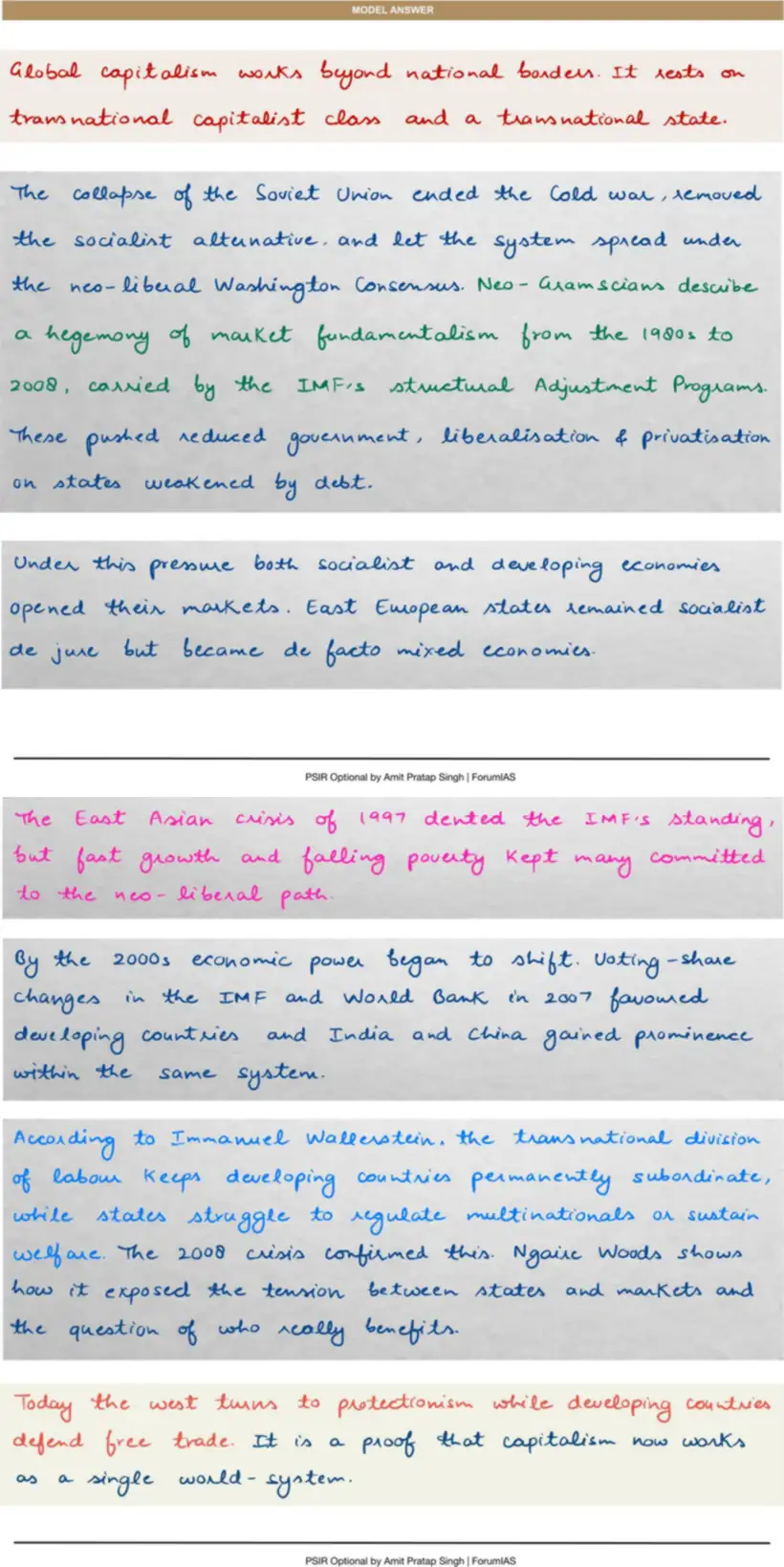
Model answer
Handwritten, in the form it would be written in the examination hall.
Also asked on this head
Globalisation — 10 questions in the Vault.
- Global South-sensitive model of globalization would prevent the danger emanating from overcentralized clobalization. Discuss.
- “Deglobalisation is displacing globalisation.” Comment.
- Critically examine the impact of Globalisation on the developing countries of the world.
How this is taught
The same flow snapshot, built for every head of the syllabus, with the answer written in class.
The first session of Foundation 2027 is published in full.
Six programmes across three levels.