
What are the main challenges faced by the developing countries in the era of globalisation?
How the answer moves
The flow snapshot — the routes in, the body, the counter-view and the routes out.
Route 1 globalisation promised integration → but redistributed economic power → developed nations dominant → challenges = unequal terms of entry
Route 2 South enters late and weak → openness on others’ terms → dependency, not partnership
economics first → skewed balance of trade (imports > exports) → job losses despite higher productivity → village/small-scale industry crushed by MNC technology → poverty + income gaps → Wallerstein: drain periphery → core = development of underdevelopment → dependence on developed nations + IMF/WTO (favour industrialised) → sovereignty eroded, external shocks → cultural erosion + environmental degradation + labour exploitation
Sen and Bhagwati → right mix of openness, regulation, infrastructure, governance → developing countries can gain
Route 1 not globalisation but its present terms → vulnerable states need regulation + equitable distribution → exposure into benefit
Route 2 challenge is management, not rejection → strategic planning turns integration from trap into opportunity
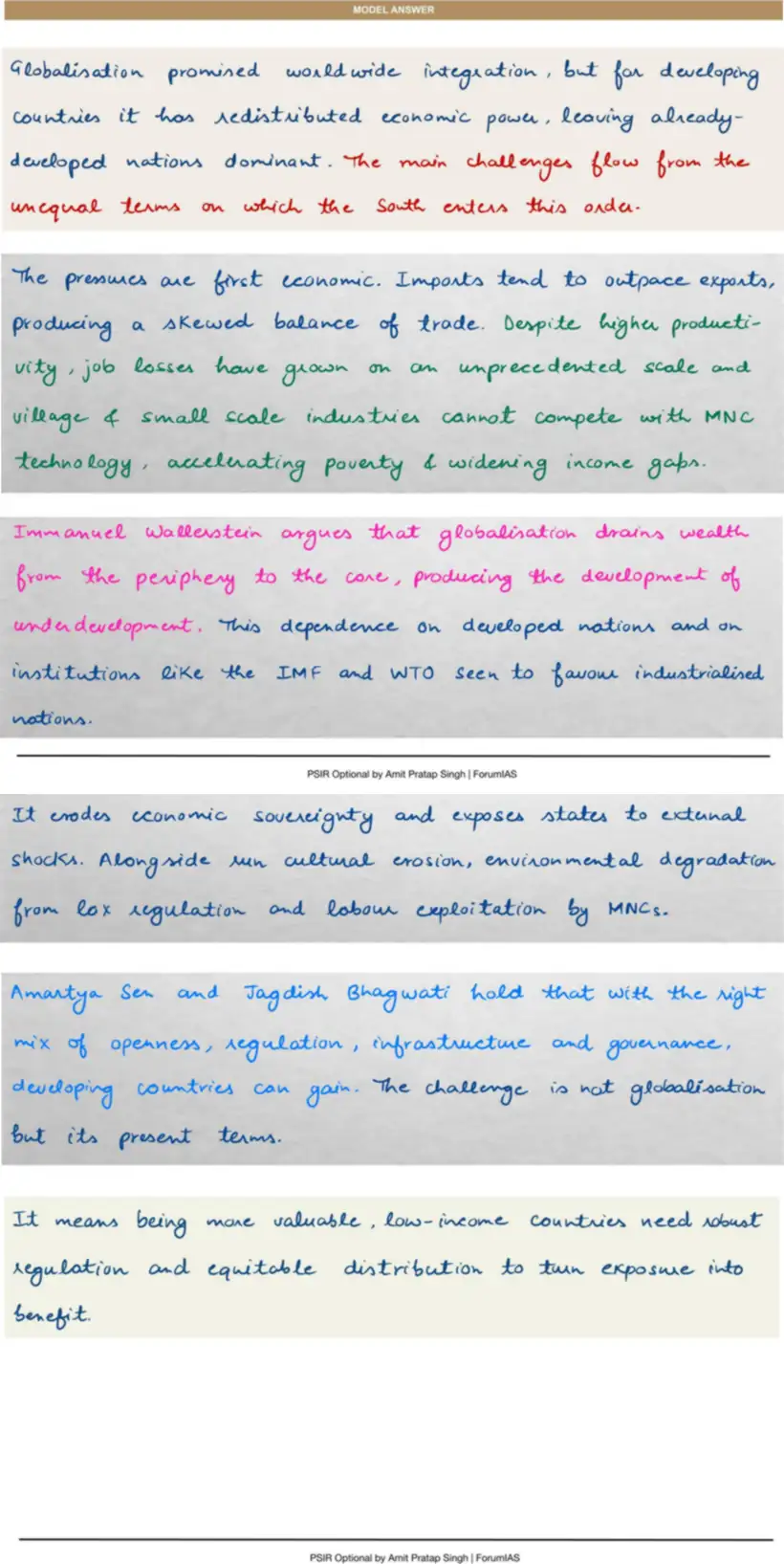
Model answer
Handwritten, in the form it would be written in the examination hall.
Also asked on this head
Globalisation — 10 questions in the Vault.
- Global South-sensitive model of globalization would prevent the danger emanating from overcentralized clobalization. Discuss.
- “Deglobalisation is displacing globalisation.” Comment.
- Critically examine the impact of Globalisation on the developing countries of the world.
How this is taught
The same flow snapshot, built for every head of the syllabus, with the answer written in class.
The first session of Foundation 2027 is published in full.
Six programmes across three levels.