
“Deglobalisation is displacing globalisation.” Comment.
How the answer moves
The flow snapshot — the routes in, the body, the counter-view and the routes out.
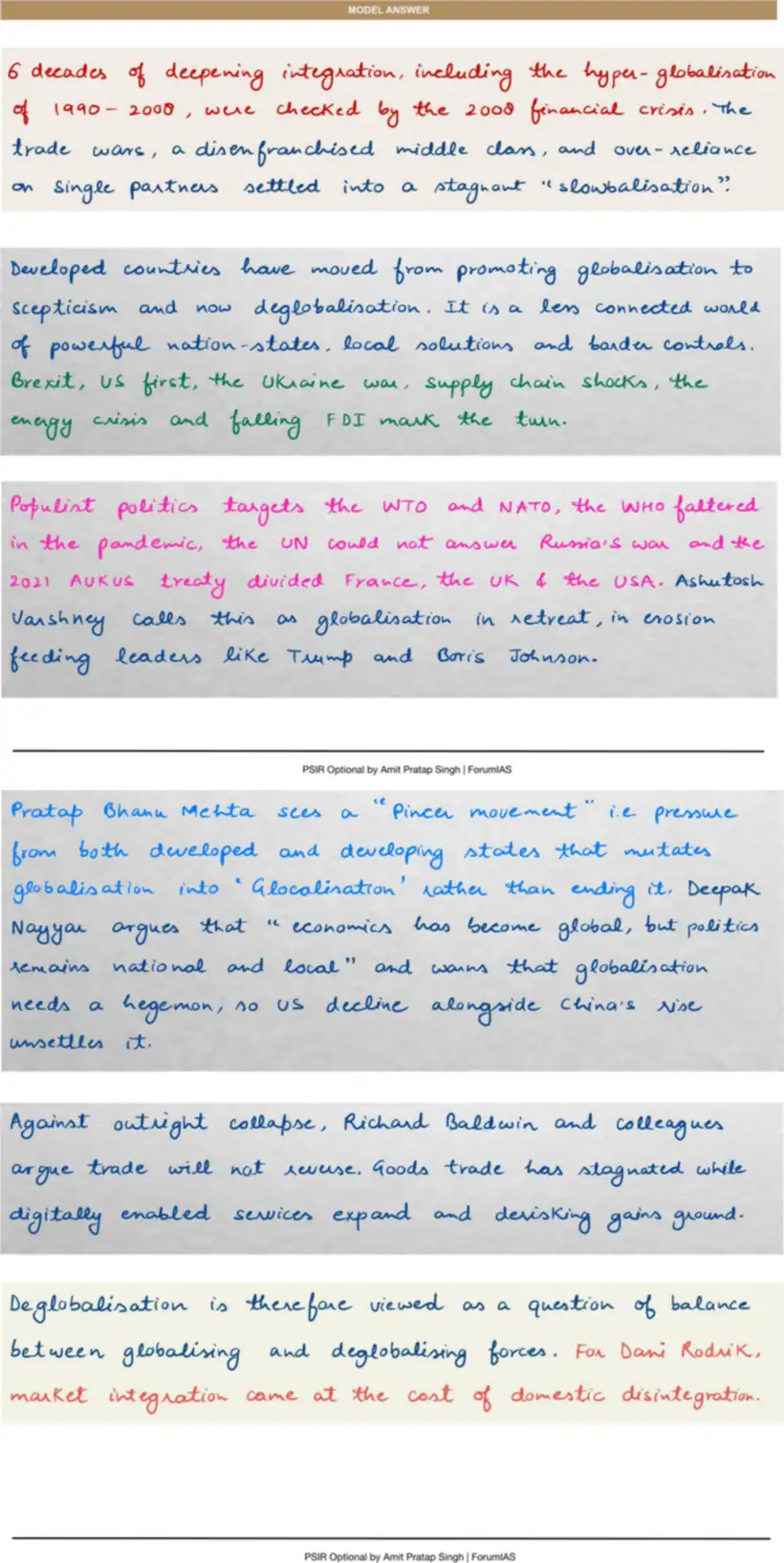
Route 1 advance never smooth → hyper-globalisation (1990–2008) → 2008 crisis + trade wars + single-partner dependence → “slowbalisation” → displacement or rebalancing?
Route 2 developed world’s three phases: promotion → scepticism → deglobalisation → stake the line: erosion, not replacement
case for displacement (Brexit, America First, Ukraine, supply-chain, energy, falling FDI) → drivers: pandemic + ideology + green transition → resilience/reshoring → institutions strained (WTO/NATO under populism; WHO + UN failures; AUKUS 2021 split) → Varshney: retreat/erosion feeding Trump, Boris Johnson → pivot: retreat ≠ replacement → Mehta: Pincer movement → mutation into Glocalisation → Nayyar: “economics global, politics national/local” + needs a hegemon (US decline vs China rise)
Baldwin et al.: trade won’t reverse → goods trade stagnant but e-services expand → “derisking,” not collapse
Route 1 balance between globalising & deglobalising forces, not displacement
Route 2 Rodrik’s “thinner model” → globalisation thins and reforms, not displaced
Model answer
Handwritten, in the form it would be written in the examination hall.
Also asked on this head
Globalisation — 10 questions in the Vault.
- Global South-sensitive model of globalization would prevent the danger emanating from overcentralized clobalization. Discuss.
- Critically examine the impact of Globalisation on the developing countries of the world.
- What are the main challenges faced by the developing countries in the era of globalisation?
How this is taught
The same flow snapshot, built for every head of the syllabus, with the answer written in class.
The first session of Foundation 2027 is published in full.
Six programmes across three levels.