
Explain the relevance of the Marxist approach in the context of globalization.
How the answer moves
The flow snapshot — the routes in, the body, the counter-view and the routes out.
Route 1 liberal framing (prosperity / integration) → Marxism reframes as extension of capitalist exploitation → relevance follows from the reframing
Route 2 economic structures / class relations / historical materialism → classes, not states, as primary actors → exposes hidden inequality and dependency
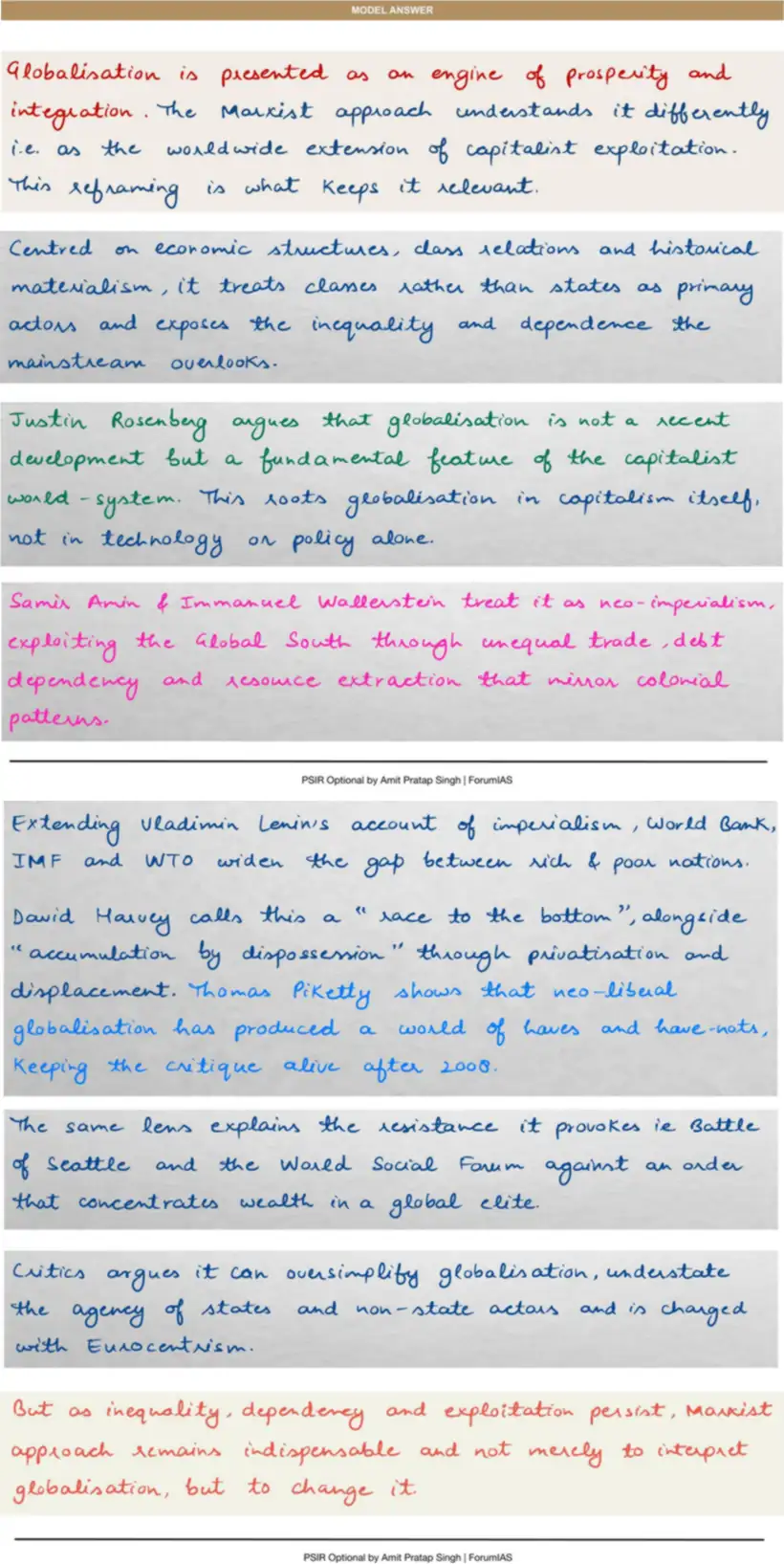
Rosenberg: globalisation not new, built into the capitalist world-system / uneven and combined development → Amin + Wallerstein: neo-imperialism, Global South, unequal trade–debt–extraction → Lenin lineage: WB / IMF / WTO widen the rich–poor gap → Harvey: “race to the bottom” + “accumulation by dispossession,” precarious labour → Piketty: haves / have-nots, critique alive post-2008 → explains resistance: Battle of Seattle, World Social Forum, wealth in a global elite
reductionist → oversimplifies globalisation, understates state and non-state agency → charged with Eurocentrism
Route 1 inequality / dependency / exploitation persist → indispensable as a critique
Route 2 emancipatory theory → not merely to interpret globalisation but to change it
Model answer
Handwritten, in the form it would be written in the examination hall.
Also asked on this head
Globalisation — 10 questions in the Vault.
- Global South-sensitive model of globalization would prevent the danger emanating from overcentralized clobalization. Discuss.
- “Deglobalisation is displacing globalisation.” Comment.
- Critically examine the impact of Globalisation on the developing countries of the world.
How this is taught
The same flow snapshot, built for every head of the syllabus, with the answer written in class.
The first session of Foundation 2027 is published in full.
Six programmes across three levels.