
Discuss the impact of globalization on the internal functioning of the state.
How the answer moves
The flow snapshot — the routes in, the body, the counter-view and the routes out.
Route 1 globalisation multidimensional (economic/political/social/cultural) → question is not “does it end the state” but “how far does it loosen the state’s grip” → realists: erosion of sovereignty // liberals: capacity-building
Route 2 political globalisation erodes sovereignty despite the Westphalian principle → nation-state’s weight falls, other actors rise → domestic control becomes the real pressure point
economic pressure first (Nye → MNCs press governments, control over currency & foreign trade weakened) → authority sideways to society (Simmons → NGOs set agendas, confer legitimacy on policy) → power upward (Rodrik → post-sovereign, transnational governance fills regulatory voids)
not pure loss → same openness brings integration, technology transfer, better governance & rule of law → state gains capacity even while ceding autonomy (liberal read against the erosion thesis)
Route 1 transforms, does not abolish → decisions move upward (international bodies) + sideways (markets, civil society) → policy & welfare space shrinks, worst in developing countries
Route 2 double-edged: state neither fully sovereign as before nor obsolete → it survives by adapting → developing states most squeezed
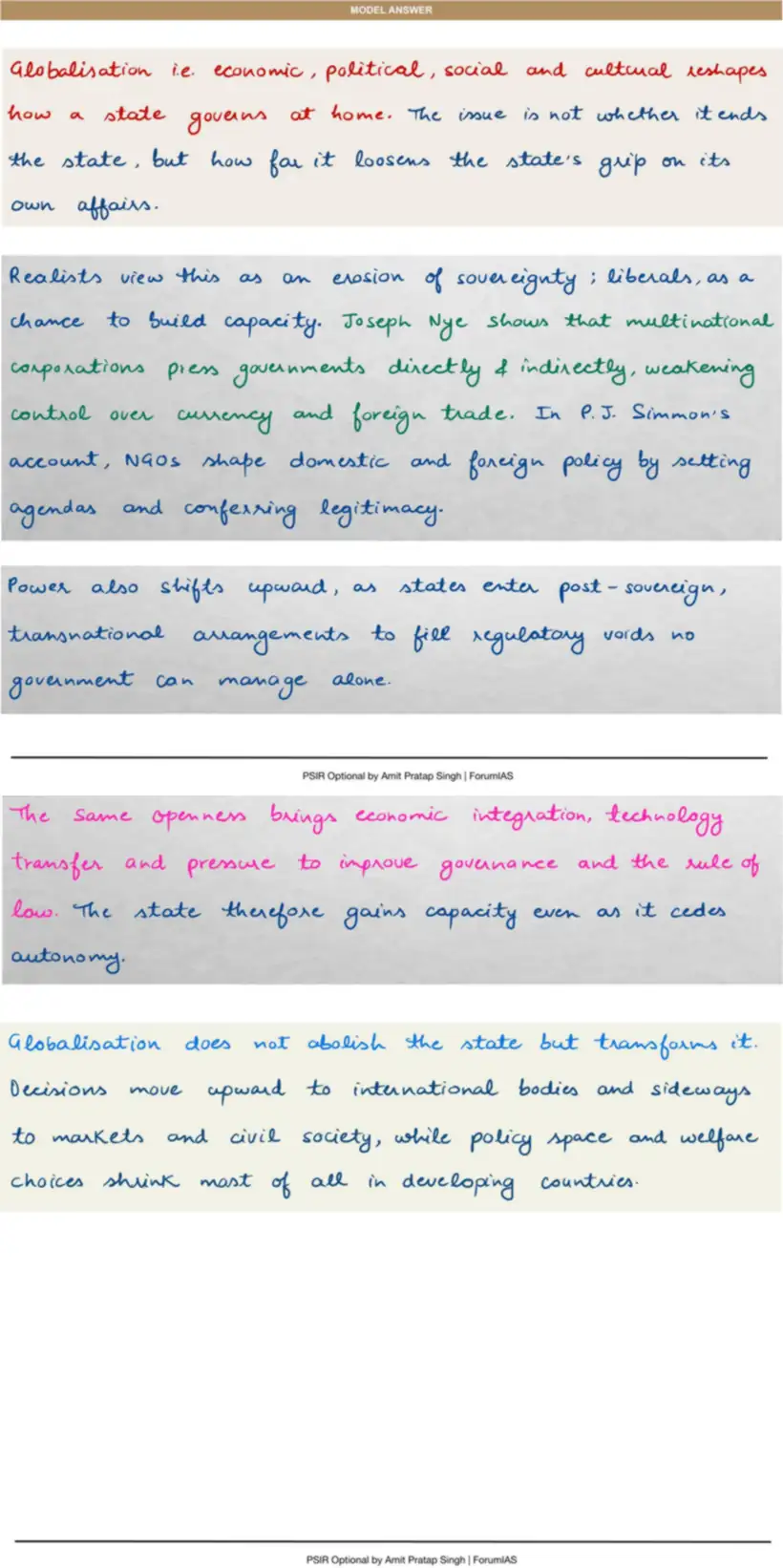
Model answer
Handwritten, in the form it would be written in the examination hall.
Also asked on this head
Globalisation — 10 questions in the Vault.
- Global South-sensitive model of globalization would prevent the danger emanating from overcentralized clobalization. Discuss.
- “Deglobalisation is displacing globalisation.” Comment.
- Critically examine the impact of Globalisation on the developing countries of the world.
How this is taught
The same flow snapshot, built for every head of the syllabus, with the answer written in class.
The first session of Foundation 2027 is published in full.
Six programmes across three levels.