
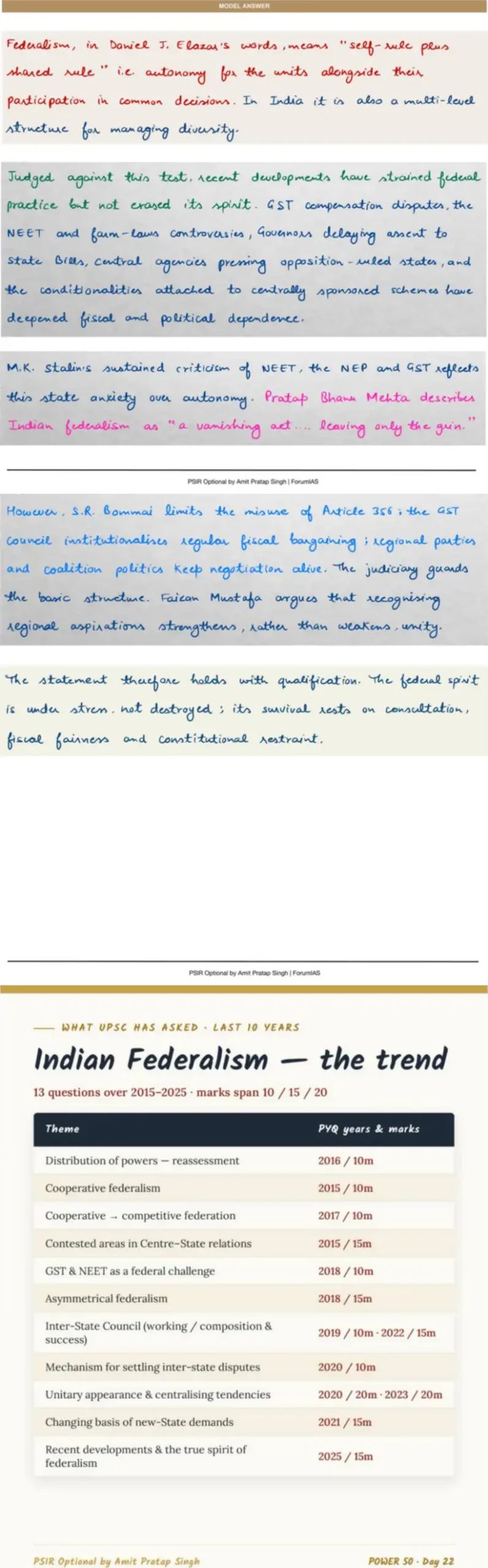
The recent developments in Indian Politics has not eroded the true spirit of federalism in India. Critically examine this statement with the help of appropriate examples.
How the answer moves
The flow snapshot — the routes in, the body, the counter-view and the routes out.
Route 1 Elazar’s “self-rule + shared rule” test → developments strain but do not erase spirit
Route 2 federalism as India’s multi-level device for diversity → “not eroded” claim must be tested against recent practice
self-rule/shared-rule benchmark → fiscal-political pressures: GST compensation, NEET/farm laws, Governor delays, central agencies, scheme conditionalities → Stalin’s NEET/NEP/GST critique → Mehta “vanishing act… grin” → reads as recentralisation
resilience holds the spirit → S.R. Bommai caps Art. 356 → GST Council institutionalises bargaining → regional parties/coalitions sustain negotiation → judiciary guards basic structure → asymmetry + State welfare innovation → Mustafa: regional aspirations strengthen unity
Route 1 statement holds with qualification → spirit strained, not destroyed
Route 2 survival rests on consultation, fiscal fairness, constitutional restraint → a negotiated, resilient federation
Model answer
Handwritten, in the form it would be written in the examination hall.
Also asked on this head
Federalism — 13 questions in the Vault.
- Discuss the causes and consequences of inter-State water disputes in India.
- Evaluate the Centre-State relation with reference to Article 293 and analyze its implications for the Indian federal structure.
- Does the actual working of Indian federalism conform to the centralizing tendencies in Indian polity? Give reasons for your answer.
How this is taught
The same flow snapshot, built for every head of the syllabus, with the answer written in class.
The first session of Foundation 2027 is published in full.
Six programmes across three levels.