
Comment on the Mechanism for settling inter-state disputes in 150 words.
How the answer moves
The flow snapshot — the routes in, the body, the counter-view and the routes out.
Route 1 divided powers/interests → disputes built into the system → Constitution offers judicial + extra-judicial mechanisms
Route 2 federalism breeds conflict by design → Constitution responds through courts, tribunals and councils
Article 131 (SC exclusive original jurisdiction, legal not political) → Article 262 (Parliament, river water disputes, ousts Court, ISWD Act 1956 tribunals) → Article 263 Inter-State Council advisory + Zonal Councils / NITI Aayog / mediation / GST Council → rationale: many disputes political, not merely legal
water tribunal system the weak link → delay in constitution + award, weak enforcement, Article 136 appeals despite Article 262 bar → Nariman: innovative experiment that failed in performance
Route 1 mechanism layered but uneven → needs basin-wide, cooperative reform
Route 2 2019 Bill (permanent tribunal, Disputes Resolution Committee) only partly repairs the gap
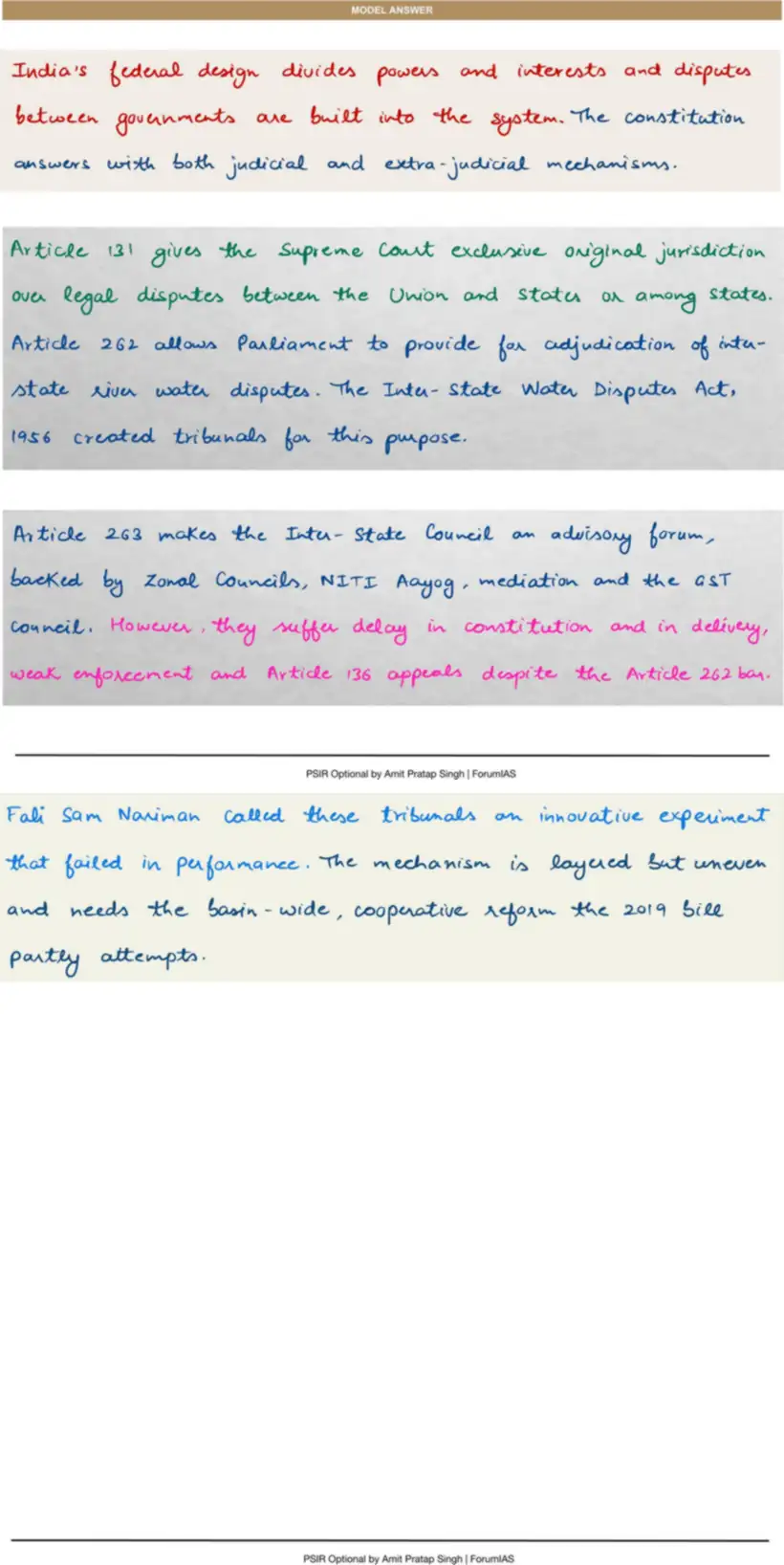
Model answer
Handwritten, in the form it would be written in the examination hall.
Also asked on this head
Federalism — 11 questions in the Vault.
- The recent developments in Indian Politics has not eroded the true spirit of federalism in India. Critically examine this statement with the help of appropriate examples.
- Does the actual working of Indian federalism conform to the centralizing tendencies in Indian polity? Give reasons for your answer.
- Discuss the composition and functions of the Inter-State Council. To what extent has this body been successful in achieving its objectives?
How this is taught
The same flow snapshot, built for every head of the syllabus, with the answer written in class.
The first session of Foundation 2027 is published in full.
Six programmes across three levels.