
Discuss asymmetrical federalism in India.
How the answer moves
The flow snapshot — the routes in, the body, the counter-view and the routes out.
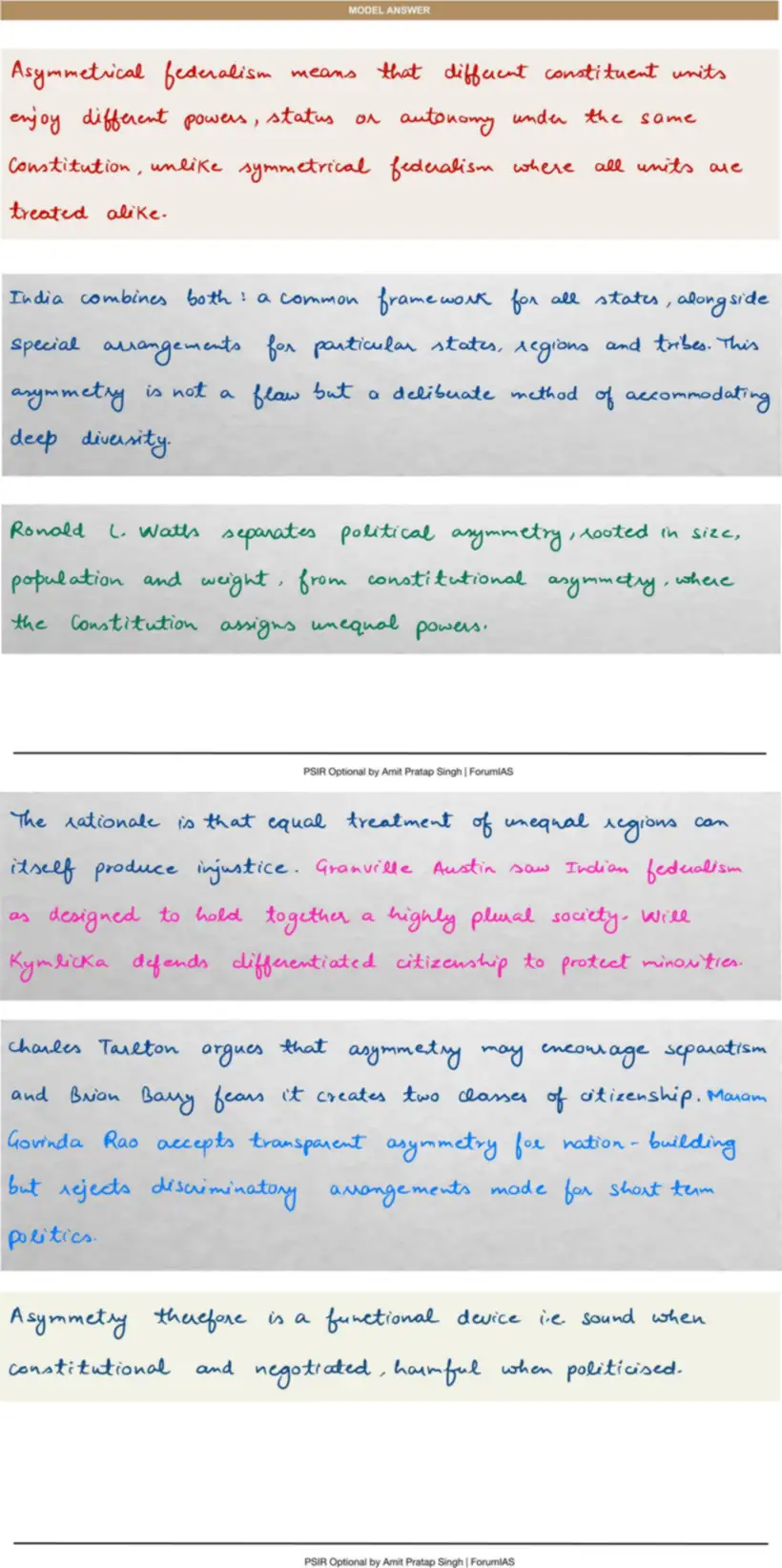
Route 1 asymmetry = different units, different powers/status under one Constitution → contrast with symmetry → not a flaw but a device
Route 2 India blends common framework (symmetry) + special arrangements (asymmetry) → tool to accommodate deep diversity
Watts: political asymmetry (size/population/weight) vs constitutional asymmetry → vertical/horizontal, de jure/de facto → Indian forms: Art 370 (pre-2019), Art 371 series, Fifth & Sixth Schedules, UTs with legislatures (Delhi, Puducherry) → rationale: equal treatment of unequal regions breeds injustice → Austin (hold together a plural society) + Kymlicka (differentiated citizenship)
Tarlton (separatism) + Barry (two classes of citizenship) → Govinda Rao: transparent asymmetry serves nation-building, discriminatory asymmetry harms unity
Route 1 functional device, not a defect → sound when constitutional, transparent, negotiated
Route 2 harmful when politicised / arbitrary → its worth depends on how it is used
Model answer
Handwritten, in the form it would be written in the examination hall.
Also asked on this head
Federalism — 13 questions in the Vault.
- Discuss the causes and consequences of inter-State water disputes in India.
- Evaluate the Centre-State relation with reference to Article 293 and analyze its implications for the Indian federal structure.
- The recent developments in Indian Politics has not eroded the true spirit of federalism in India. Critically examine this statement with the help of appropriate examples.
How this is taught
The same flow snapshot, built for every head of the syllabus, with the answer written in class.
The first session of Foundation 2027 is published in full.
Six programmes across three levels.