
Indian federation has moved from cooperative federation to competitive federation
How the answer moves
The flow snapshot — the routes in, the body, the counter-view and the routes out.
Route 1 claim only partly true → cooperation supplemented, not replaced
Route 2 Austin’s cooperative base intact → competition added as a new layer
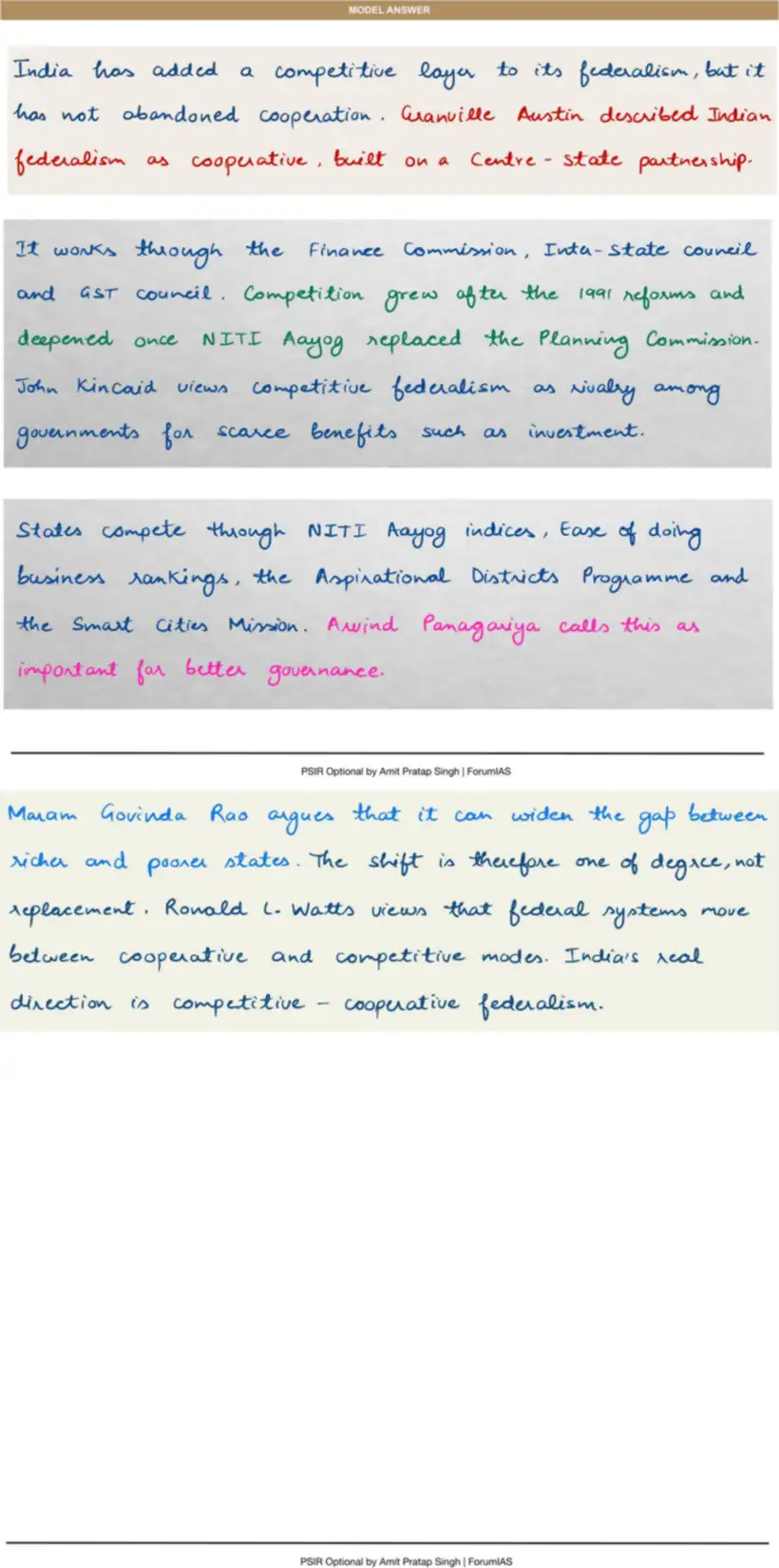
Austin: cooperative Centre-State partnership (Finance Commission, ISC, GST Council) → 1991 reforms + NITI Aayog replaces Planning Commission → Kincaid: rivalry for investment → instruments (NITI indices, Ease of Doing Business, Aspirational Districts, Smart Cities) → Panagariya: spur to governance
Rao: competition widens the richer–poorer State gap
Route 1 shift is of degree, not replacement → Watts: systems move between both modes
Route 2 India’s real direction is competitive-cooperative federalism
Model answer
Handwritten, in the form it would be written in the examination hall.
Also asked on this head
Federalism — 13 questions in the Vault.
- Discuss the causes and consequences of inter-State water disputes in India.
- Evaluate the Centre-State relation with reference to Article 293 and analyze its implications for the Indian federal structure.
- The recent developments in Indian Politics has not eroded the true spirit of federalism in India. Critically examine this statement with the help of appropriate examples.
How this is taught
The same flow snapshot, built for every head of the syllabus, with the answer written in class.
The first session of Foundation 2027 is published in full.
Six programmes across three levels.