
Implementation of GST and NEET is a major challenge to Indian Federalism.
How the answer moves
The flow snapshot — the routes in, the body, the counter-view and the routes out.
Route 1 both reforms push national uniformity over State discretion → that is the federal challenge
Route 2 GST and NEET pull power upward → fiscal and education-health autonomy narrowed
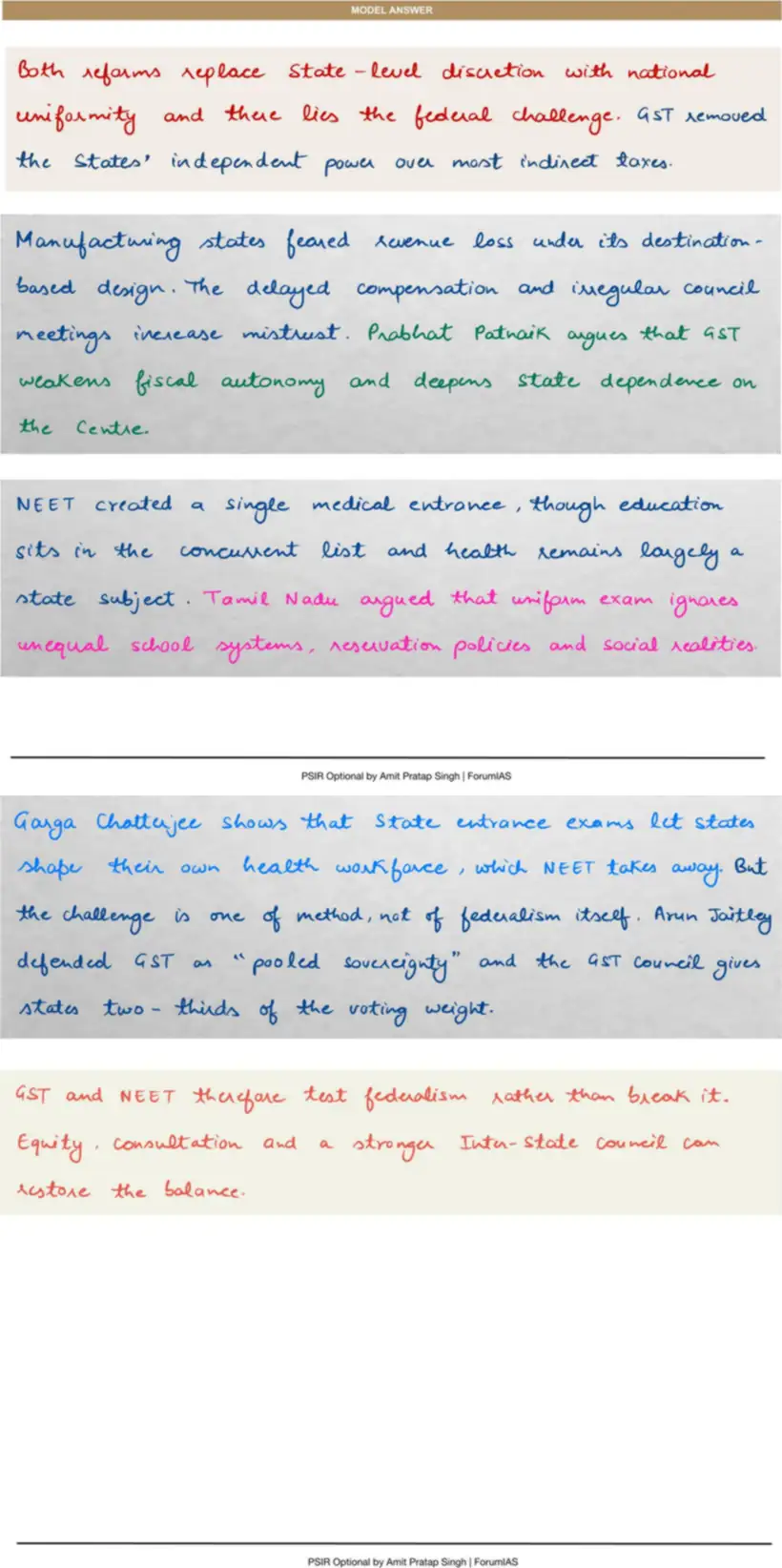
GST removes States’ indirect-tax power → destination-based design, manufacturing States fear revenue loss → delayed compensation + irregular Council meetings → mistrust → Patnaik: fiscal autonomy weakened, dependence deepened → NEET’s uniform entrance vs education (Concurrent) + health (State) → Tamil Nadu: ignores school inequality + reservation → Garga Chatterjee: States lose power to shape health workforce
challenge of method, not federalism → Jaitley “pooled sovereignty” + GST Council’s two-thirds State weight show cooperative design
Route 1 GST and NEET test federalism, do not break it → equity, consultation, stronger Inter-State Council restore balance
Route 2 core tension is national uniformity vs State autonomy → resolved through consultation, not centralisation
Model answer
Handwritten, in the form it would be written in the examination hall.
Also asked on this head
Federalism — 13 questions in the Vault.
- Discuss the causes and consequences of inter-State water disputes in India.
- Evaluate the Centre-State relation with reference to Article 293 and analyze its implications for the Indian federal structure.
- The recent developments in Indian Politics has not eroded the true spirit of federalism in India. Critically examine this statement with the help of appropriate examples.
How this is taught
The same flow snapshot, built for every head of the syllabus, with the answer written in class.
The first session of Foundation 2027 is published in full.
Six programmes across three levels.