
Discuss the composition and functions of the Inter-State Council. To what extent has this body been successful in achieving its objectives?
How the answer moves
The flow snapshot — the routes in, the body, the counter-view and the routes out.
Route 1 ISC as the chief institution of cooperative federalism → Art 263, set up 1990 on Sarkaria recommendation
Route 2 shared-rule forum under Art 263 → President establishes it when public interest requires
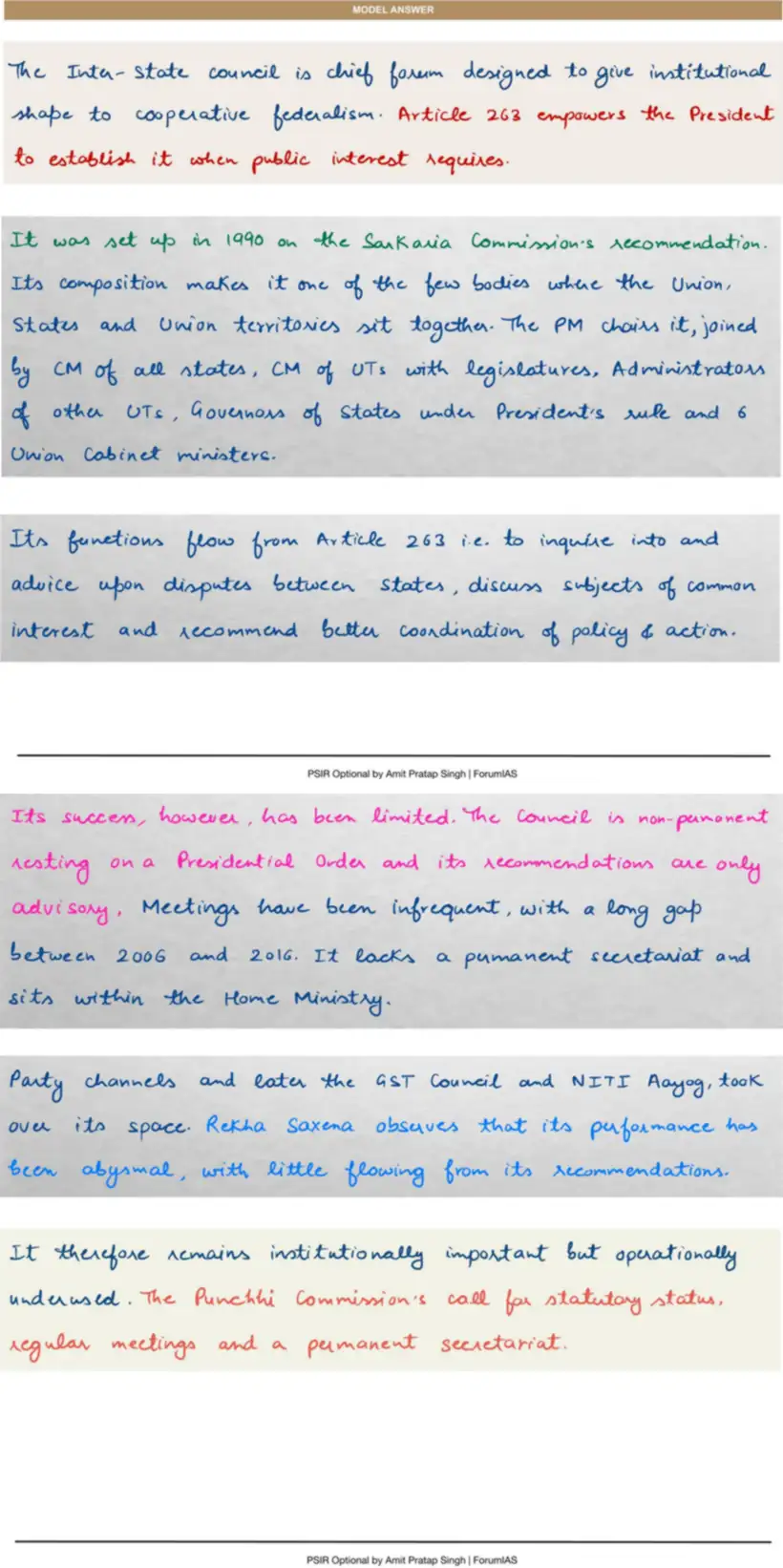
composition: a rare body uniting Union, States, UTs → PM as chair + State CMs + UT CMs with legislatures + Administrators of other UTs + Governors under President’s Rule + six Union Cabinet Ministers → functions under Art 263: inquire into and advise on inter-State disputes → discuss subjects of common interest → recommend coordination of policy and action
(success limited) → non-permanent Presidential Order → advisory, non-binding → infrequent meetings, 2006–2016 gap → weak secretariat under Home Ministry → bypassed by party channels, GST Council, NITI Aayog → Saxena: abysmal performance
Route 1 institutionally important but operationally underused
Route 2 Punchhi reforms — statutory status, regular meetings, permanent secretariat — to give it real weight
Model answer
Handwritten, in the form it would be written in the examination hall.
Also asked on this head
Federalism — 13 questions in the Vault.
- Discuss the causes and consequences of inter-State water disputes in India.
- Evaluate the Centre-State relation with reference to Article 293 and analyze its implications for the Indian federal structure.
- The recent developments in Indian Politics has not eroded the true spirit of federalism in India. Critically examine this statement with the help of appropriate examples.
How this is taught
The same flow snapshot, built for every head of the syllabus, with the answer written in class.
The first session of Foundation 2027 is published in full.
Six programmes across three levels.