
Despite constitutional mandate the Inter-State Council has not come of age. Discuss.
How the answer moves
The flow snapshot — the routes in, the body, the counter-view and the routes out.
Route 1 Art. 263 mandate (inquire → discuss → recommend) → yet no maturation since its 1990 birth under Sarkaria
Route 2 meant to be the principal federal forum → has not grown into one
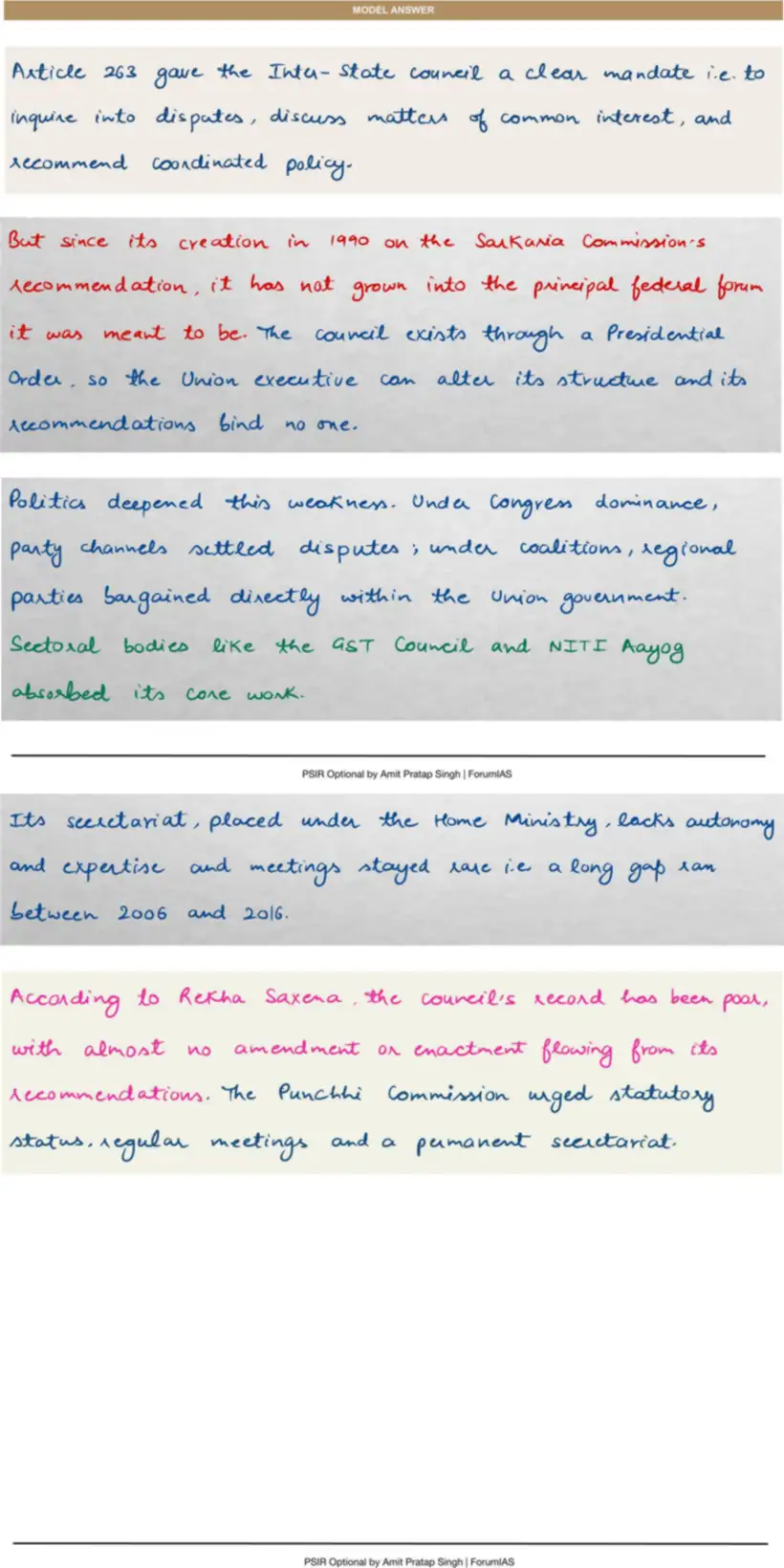
root cause is design → exists only by Presidential Order → executive can alter its structure → recommendations bind no one → politics widens the gap → Congress dominance (party channels settle disputes) → coalitions (regional parties bargain directly within Union) → sectoral bodies (GST Council, NITI Aayog) absorb its core work → secretariat under Home Ministry → no autonomy or expertise → meetings rare (2006–2016 gap) → Rekha Saxena → poor record, almost no amendment or enactment
not beyond repair → Punchhi Commission → statutory status, regular meetings, permanent secretariat
Route 1 reactivated on these lines → gives cooperative federalism real substance
Route 2 the constitutional mandate is intact → only political will and a structural fix are missing
Model answer
Handwritten, in the form it would be written in the examination hall.
Also asked on this head
Federalism — 13 questions in the Vault.
- Discuss the causes and consequences of inter-State water disputes in India.
- Evaluate the Centre-State relation with reference to Article 293 and analyze its implications for the Indian federal structure.
- The recent developments in Indian Politics has not eroded the true spirit of federalism in India. Critically examine this statement with the help of appropriate examples.
How this is taught
The same flow snapshot, built for every head of the syllabus, with the answer written in class.
The first session of Foundation 2027 is published in full.
Six programmes across three levels.