
Does the actual working of Indian federalism conform to the centralizing tendencies in Indian polity? Give reasons for your answer.
How the answer moves
The flow snapshot — the routes in, the body, the counter-view and the routes out.
Route 1 federal in form, but Centre-tilted by design → actual working confirms the tilt
Route 2 Wheare’s “quasi-federal” → Partition / integration / secession / uneven development explain the strong Union
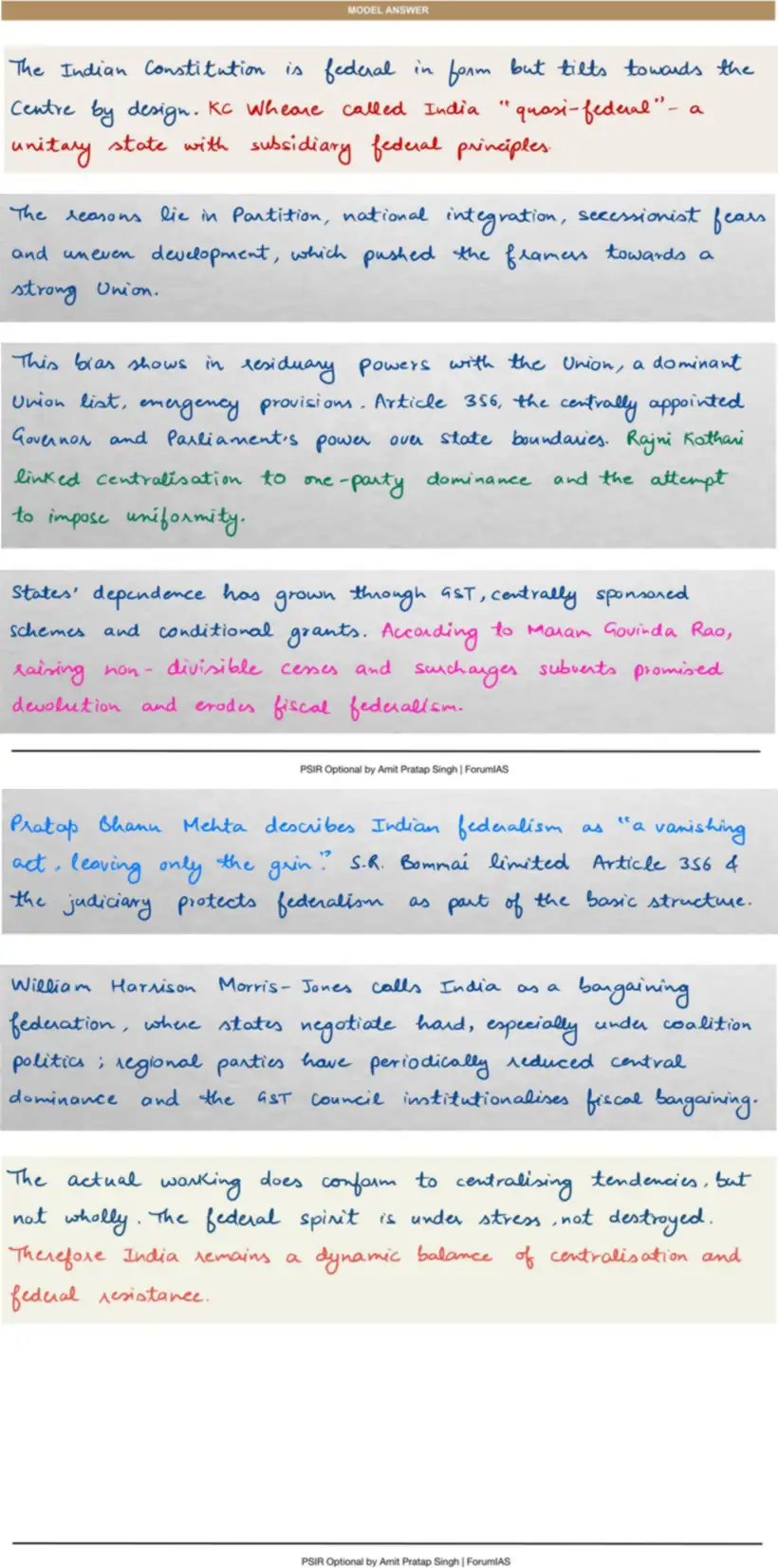
constitutional bias (residuary powers, Union List, emergency, Art. 356, Governor, boundary power under Arts. 2–3) → political centralisation (Kothari → one-party dominance; Indira era misuse of 356, Emergency, Governor) → fiscal centralisation (GST, CSS, conditional grants; Govinda Rao on cesses/surcharges) → administrative centralisation (AIS, central agencies, Governor’s discretion; Mehta’s “vanishing act”)
conformity not complete → Bommai limits 356, judiciary guards basic structure → Morris-Jones’s bargaining federation → coalition politics + regional parties + GST Council bargaining
Route 1 conforms, but not wholly → federal spirit stressed, not destroyed
Route 2 dynamic balance of centralisation and federal resistance
Model answer
Handwritten, in the form it would be written in the examination hall.
Also asked on this head
Federalism — 13 questions in the Vault.
- Discuss the causes and consequences of inter-State water disputes in India.
- Evaluate the Centre-State relation with reference to Article 293 and analyze its implications for the Indian federal structure.
- The recent developments in Indian Politics has not eroded the true spirit of federalism in India. Critically examine this statement with the help of appropriate examples.
How this is taught
The same flow snapshot, built for every head of the syllabus, with the answer written in class.
The first session of Foundation 2027 is published in full.
Six programmes across three levels.