
Do you think that there has been a gradual shift in the basis on which the demands for the creation of new States have been raised in different regions of India? Explain.
How the answer moves
The flow snapshot — the routes in, the body, the counter-view and the routes out.
Route 1 no single basis → ground steadily shifted → Tillin’s four phases
Route 2 statehood demands not static → basis evolves region to region → frame the answer as a phased shift
Phase 1 (1950s–60s) language / SRA 1956 / Guha “master stroke” preventing balkanisation → Phase 2 (1970s–80s) ethnicity & tribal identity / North-East, Gorkhaland, Bodoland → Phase 3 (1990s) political economy / Kohli / liberalisation & resource control / Chhattisgarh → Phase 4 (this century) development, governance, neglect / Telangana, Vidarbha, Bundelkhand, Purvanchal / Yadav → marginalised assertion for power & development
shift not clean → Jaffrelot: political timing & ruling-party calculation decide actual creation → Mahendra Prasad Singh: smaller States ≠ automatic better governance
Route 1 basis moved from language/identity → development/viability
Route 2 shift is real but cumulative → older claims persist alongside the new
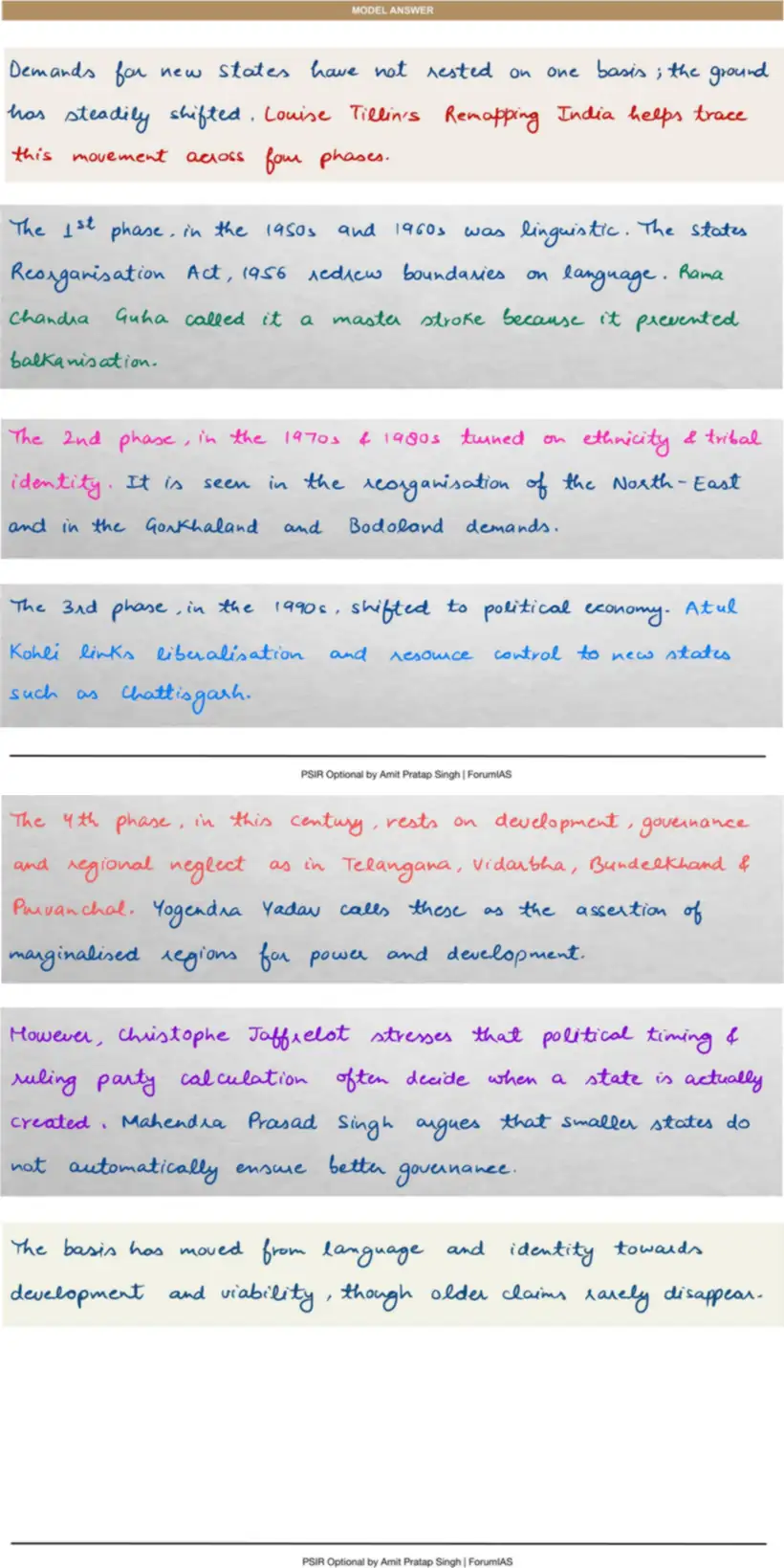
Model answer
Handwritten, in the form it would be written in the examination hall.
Also asked on this head
Federalism — 13 questions in the Vault.
- Discuss the causes and consequences of inter-State water disputes in India.
- Evaluate the Centre-State relation with reference to Article 293 and analyze its implications for the Indian federal structure.
- The recent developments in Indian Politics has not eroded the true spirit of federalism in India. Critically examine this statement with the help of appropriate examples.
How this is taught
The same flow snapshot, built for every head of the syllabus, with the answer written in class.
The first session of Foundation 2027 is published in full.
Six programmes across three levels.