
Cultural and Regional differences are the enduring bases on which politics is played out in India.
How the answer moves
The flow snapshot — the routes in, the body, the counter-view and the routes out.
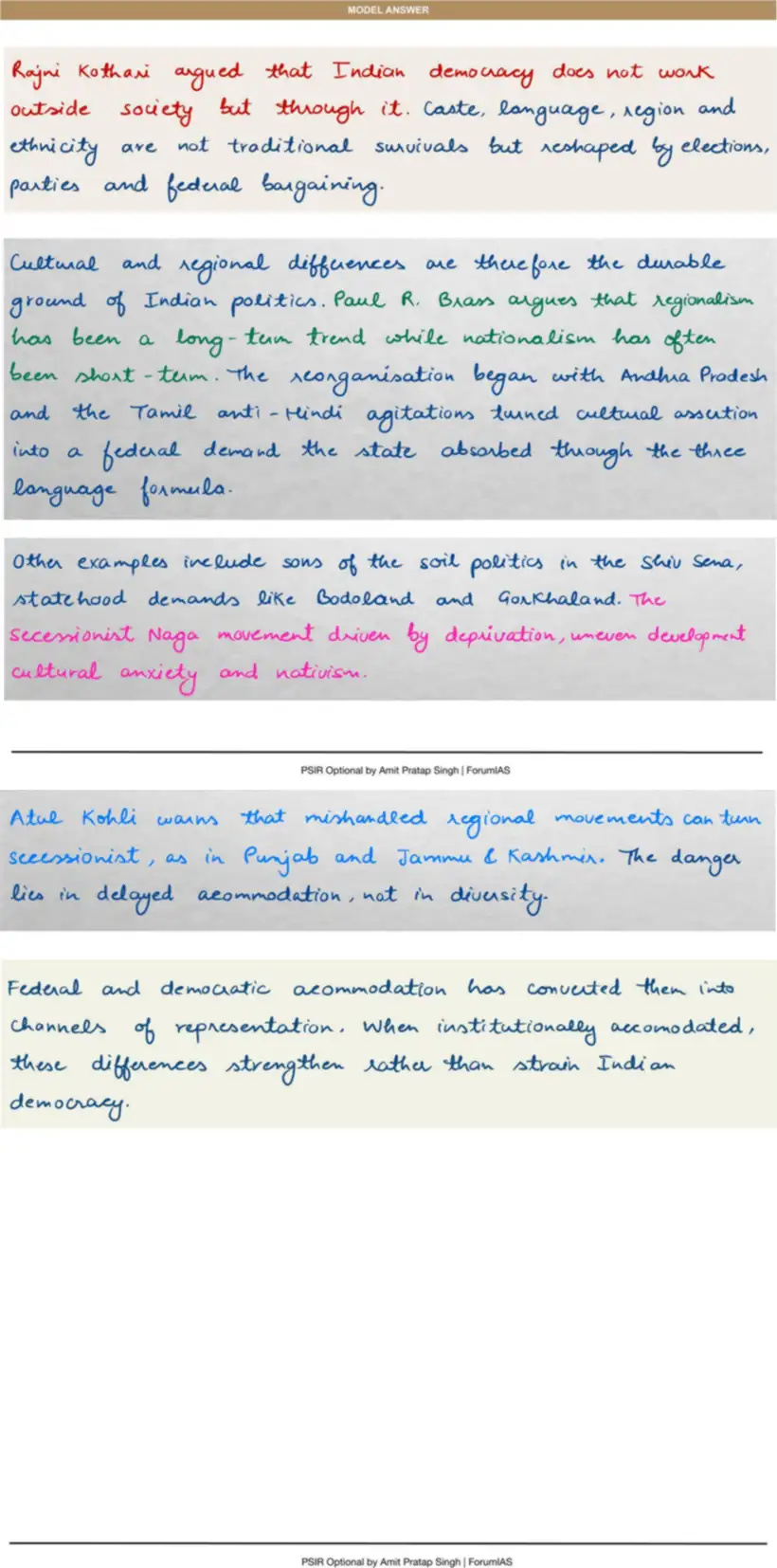
Route 1 Kothari: democracy works through society, not outside it → culture / region as durable ground, not mere survivals
Route 2 India a mosaic of language–culture–region → identities reshaped by elections, parties, federal bargaining → hence the standing bases of politics
Kothari framing → Brass: regionalism long-term, nationalism short-term → language proof (Andhra reorganisation → Tamil anti-Hindi → three-language formula) → varied forms (Shiv Sena sons-of-soil → Bodoland / Gorkhaland statehood → Naga secession) → drivers: deprivation, uneven development, cultural anxiety, nativism
Kohli: mishandled movements turn secessionist (Punjab, J&K) → the danger is delayed accommodation, not diversity itself
Route 1 federal–democratic accommodation converts differences into channels of representation
Route 2 institutionally accommodated, diversity strengthens rather than strains democracy
Model answer
Handwritten, in the form it would be written in the examination hall.
Also asked on this head
Caste, Religion and Ethnicity in Indian Politics — 12 questions in the Vault.
- Map the different types of ethnic conflicts that have emerged in 21st century India.
- Identity has become an important phenomenon in the modern politics in India. Discuss. (150 words)
- Caste remains a vital axis for political mobilisation in India. How would the caste census address the aspirations of people? Discuss.
How this is taught
The same flow snapshot, built for every head of the syllabus, with the answer written in class.
The first session of Foundation 2027 is published in full.
Six programmes across three levels.