
Of late, centrist and centre-left political parties have been facing setbacks while centre-right parties have been in ascendency the world over. Comment.
How the answer moves
The flow snapshot — the routes in, the body, the counter-view and the routes out.
Route 1 spectrum set by ownership → left/state–proletariat, right/private–capital, centre/liberal + social democracy → name the trend
Route 2 setbacks are real → but signal exhaustion of the post-war centrist consensus, not a settled right victory
centre-left rested on welfare-socialist consensus (SPD / Scandinavia, Keynes + welfare) → 1980s New Right (Thatcher / Reagan) broke it → state rolled back, economic ground lost → deeper cause = lost distinctiveness → Kirchheimer’s catch-all + “end of ideology” → mainstream convergence, class anchor weakens → vacuum filled → New Right returns (W. Europe, Canada, Australia, NZ) → right-wing populism = ethno-nationalism + anti-elitism → drivers: economic insecurity + cultural backlash → Trump / Le Pen / Salvini
the right is not monolithic → Burke’s moderate right (gradual change, rule of law, some welfare) vs far right (absolutist, ethnically exclusionary) → costs: strain on democratic norms, polarisation, far-right violence
Route 1 the shift is a representation gap left by a converged centre, not a durable realignment
Route 2 plural parties remain vital for minority voice and healthy competition
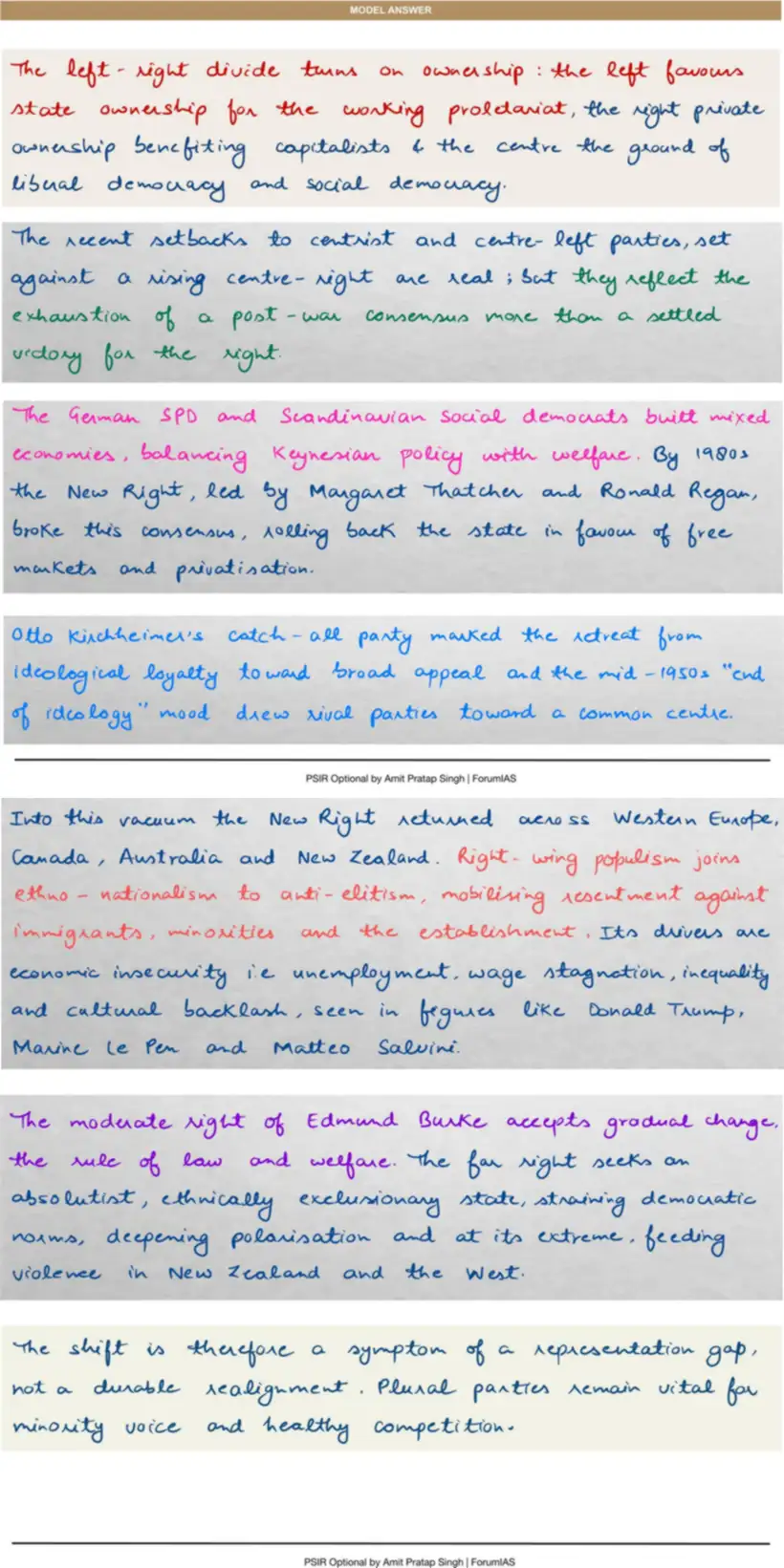
Model answer
Handwritten, in the form it would be written in the examination hall.
Also asked on this head
Politics of Representation and Participation — 14 questions in the Vault.
- Clientilism (150 words)
- How does democratic politics construct citizenship? (150 words)
- Critically examine the role of political parties in sustaining and stabilising democracies in the developing societies.
How this is taught
The same flow snapshot, built for every head of the syllabus, with the answer written in class.
The first session of Foundation 2027 is published in full.
Six programmes across three levels.