
Has the thrust of government tilted towards executive in contemporary Indian politics? Give your arguments.
How the answer moves
The flow snapshot — the routes in, the body, the counter-view and the routes out.
Route 1 Parliamentary design: executive drawn from & accountable to Lok Sabha (Art 75) → overlap natural → tilt = overlap hardening into dominance
Route 2 Question of degree, not kind → some executive strength is built-in → locate where strength starts weakening Parliament / committees / opposition
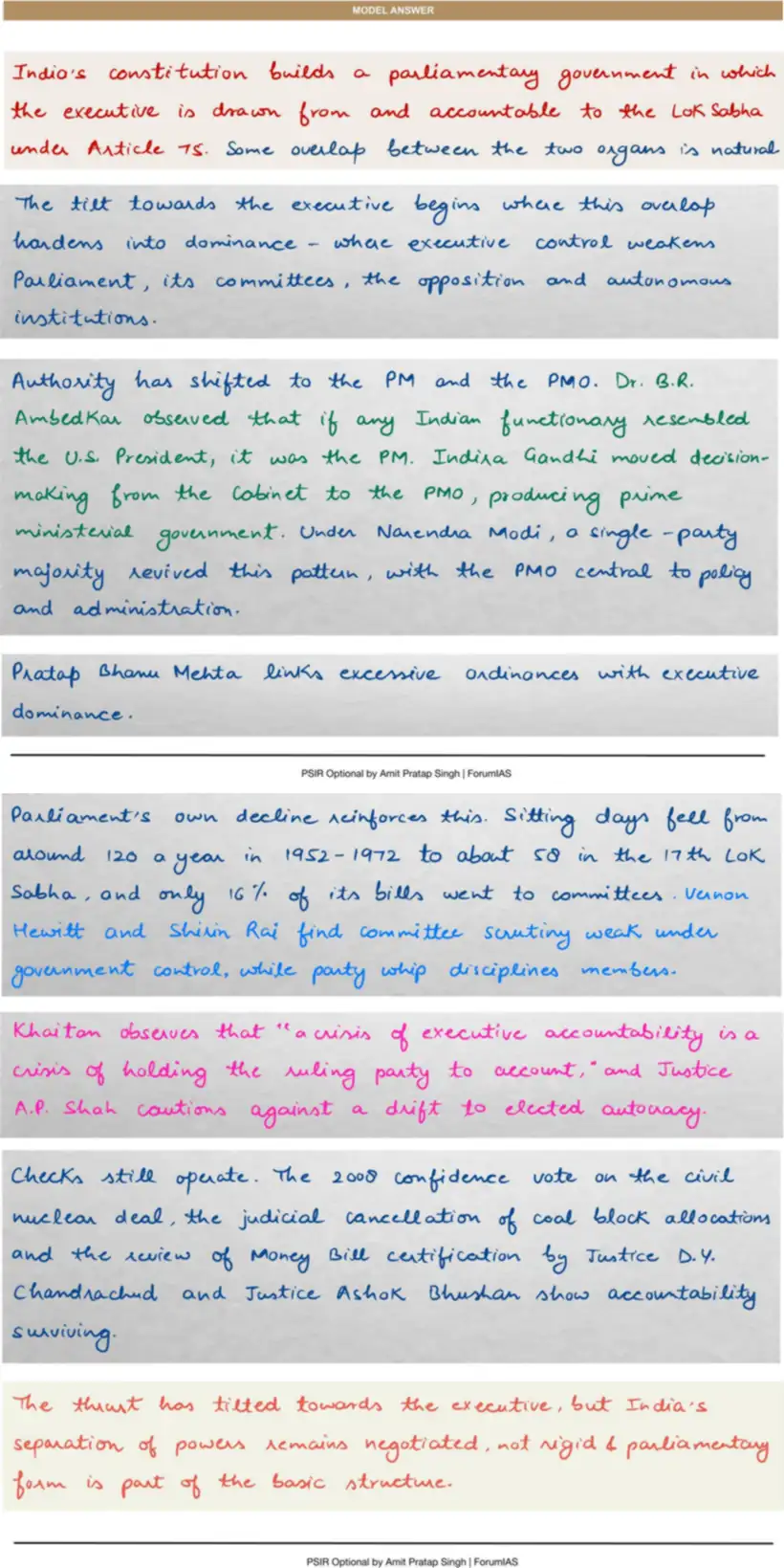
PM–PMO ascendancy (Ambedkar → Indira’s Cabinet-to-PMO shift → Modi-era PMO centrality) → executive law-making bypass (Mehta on ordinances → Krishna Kumar Singh 2017 → Money Bill / Aadhaar route) → Parliament’s decline (sitting days 120 → 58, 16% of Bills to committees → Hewitt & Rai: weak committee scrutiny → party whip → Khaitan: accountability crisis → Shah: elected autocracy)
Checks still bite: 2008 nuclear-deal confidence vote, coal-block cancellation, Money Bill review (Chandrachud, Bhushan) → Abraham: responsible govt needs a functional Parliament
Route 1 Tilt is real, but separation of powers negotiated, not rigid; the parliamentary form = basic structure
Route 2 Executive strength aids governance; the danger is unchecked dominance, not strength itself
Model answer
Handwritten, in the form it would be written in the examination hall.
Also asked on this head
Principal Organs of the Union and State Government — 17 questions in the Vault.
- Critically comment on the shifts in the functioning of the Indian Parliament in the last two decades.
- Highlight any five constitutional provisions that restrain the powers of the executive, and evaluate their effectiveness in current times.
- Analyse the arguments in favour and against the lateral entry into higher civil services in India.
How this is taught
The same flow snapshot, built for every head of the syllabus, with the answer written in class.
The first session of Foundation 2027 is published in full.
Six programmes across three levels.