
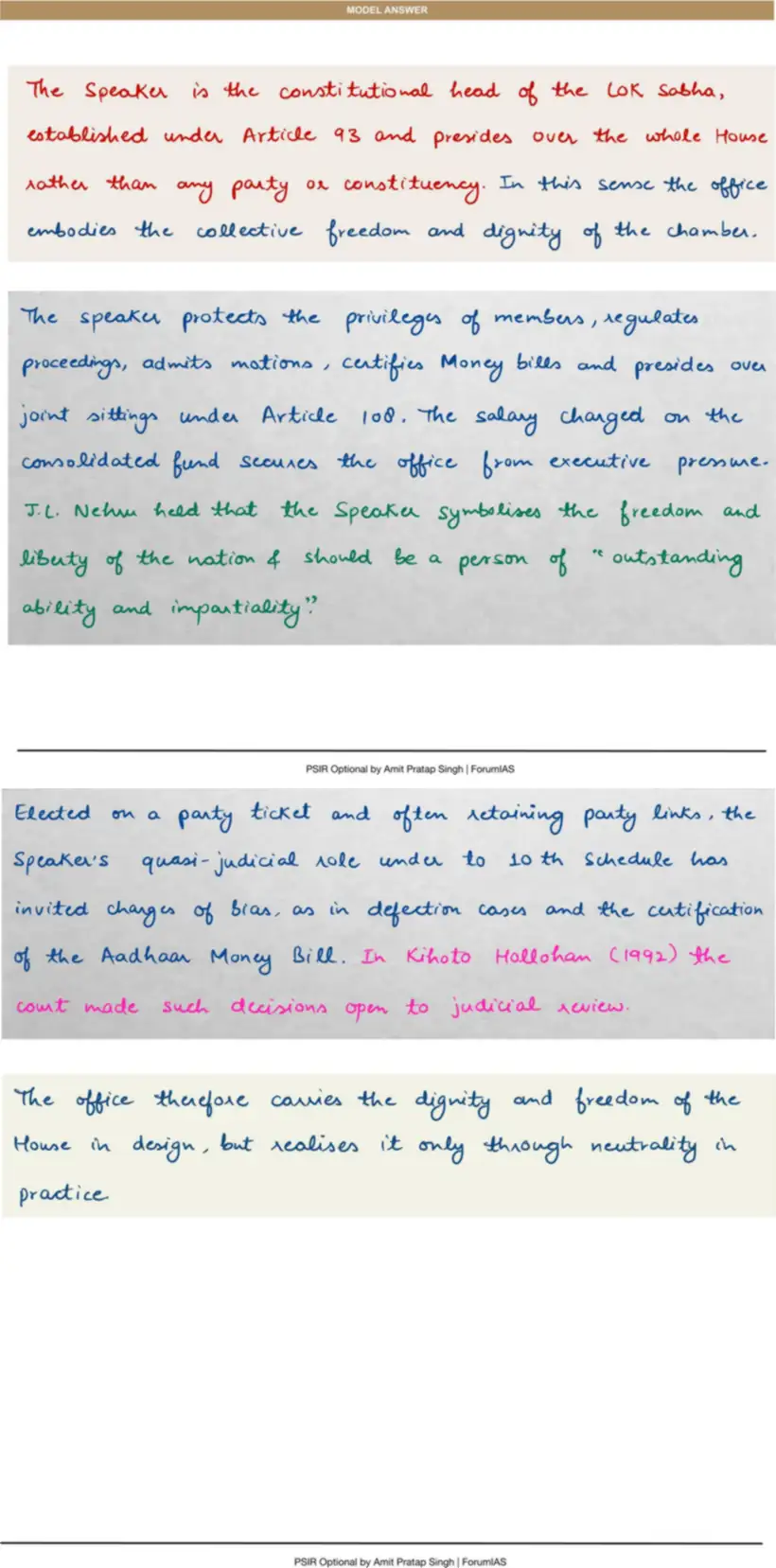
The Speaker represents the freedom and dignity of the House. Examine.
How the answer moves
The flow snapshot — the routes in, the body, the counter-view and the routes out.
Route 1 Speaker = constitutional head of the Lok Sabha (Art 93) → presides over the whole House, not a party/constituency → office embodies its freedom + dignity
Route 2 Echoes Nehru’s framing → Speaker as symbol of the House’s (and nation’s) freedom + dignity → holds in design, must be tested in practice
Art 93 position → presides over the whole House → protects privileges, regulates proceedings, admits motions, certifies Money Bills, joint sittings (Art 108) → salary on the Consolidated Fund → independence from executive → Nehru: symbol of the nation’s freedom/liberty, needs impartiality
Elected on a party ticket + retains party links → Tenth Schedule quasi-judicial role → bias charges (defection cases, Aadhaar Money Bill) → Kihoto Hollohan (1992): decisions open to judicial review
Route 1 Dignity + freedom real in design, realised only through neutrality in practice
Route 2 Holds as an ideal; partisanship is the gap; neutrality conventions + an independent defection mechanism make it true
Model answer
Handwritten, in the form it would be written in the examination hall.
Also asked on this head
Principal Organs of the Union and State Government — 17 questions in the Vault.
- Critically comment on the shifts in the functioning of the Indian Parliament in the last two decades.
- Highlight any five constitutional provisions that restrain the powers of the executive, and evaluate their effectiveness in current times.
- Analyse the arguments in favour and against the lateral entry into higher civil services in India.
How this is taught
The same flow snapshot, built for every head of the syllabus, with the answer written in class.
The first session of Foundation 2027 is published in full.
Six programmes across three levels.