
How is the President of India elected? Outline the salient characteristics of the electoral college of the Indian President.
How the answer moves
The flow snapshot — the routes in, the body, the counter-view and the routes out.
Route 1 Anchor in text: Art 54 (election) + Art 55 (manner) → President indirectly elected → a constitutional head, not a popularly-mandated executive → Ambedkar: the President is “the head of the state”, not of the executive — represents the nation but does not rule it
Route 2 Read the electoral college as a federal device → Union Parliament + State Assemblies vote together → the office mirrors the Union–State balance, not a popular majority
Composition: elected MPs (both Houses) + elected MLAs of all States + Delhi and Puducherry Assemblies (70th Amendment) → nominated members and MLCs excluded → proportional representation by single transferable vote, secret ballot (Art 55(3)) → twin principles: uniformity among States + parity between the States and the Union → MLA vote = (State population, 1971 census ÷ elected MLAs) ÷ 1000; MP vote = (total MLA votes ÷ elected MPs) → win = 50% of valid votes + 1 → disputes → Art 71 → Supreme Court, final
The design draws criticism: “uniformity” is now notional → vote values still pegged to the 1971 census (84th Amendment) while State populations diverge → the federal mirror is only partial (most UTs excluded) → indirect election + intricate formula give legitimacy but no popular mandate
Route 1 The electoral college is a deliberate design — indirect + federal + proportional → a President who is a pan-Indian symbol with Union-and-State legitimacy, not a rival power centre
Route 2 It balances democratic legitimacy with the parliamentary scheme → reform debates (census basis, UT inclusion) refine the edges, but the core logic holds
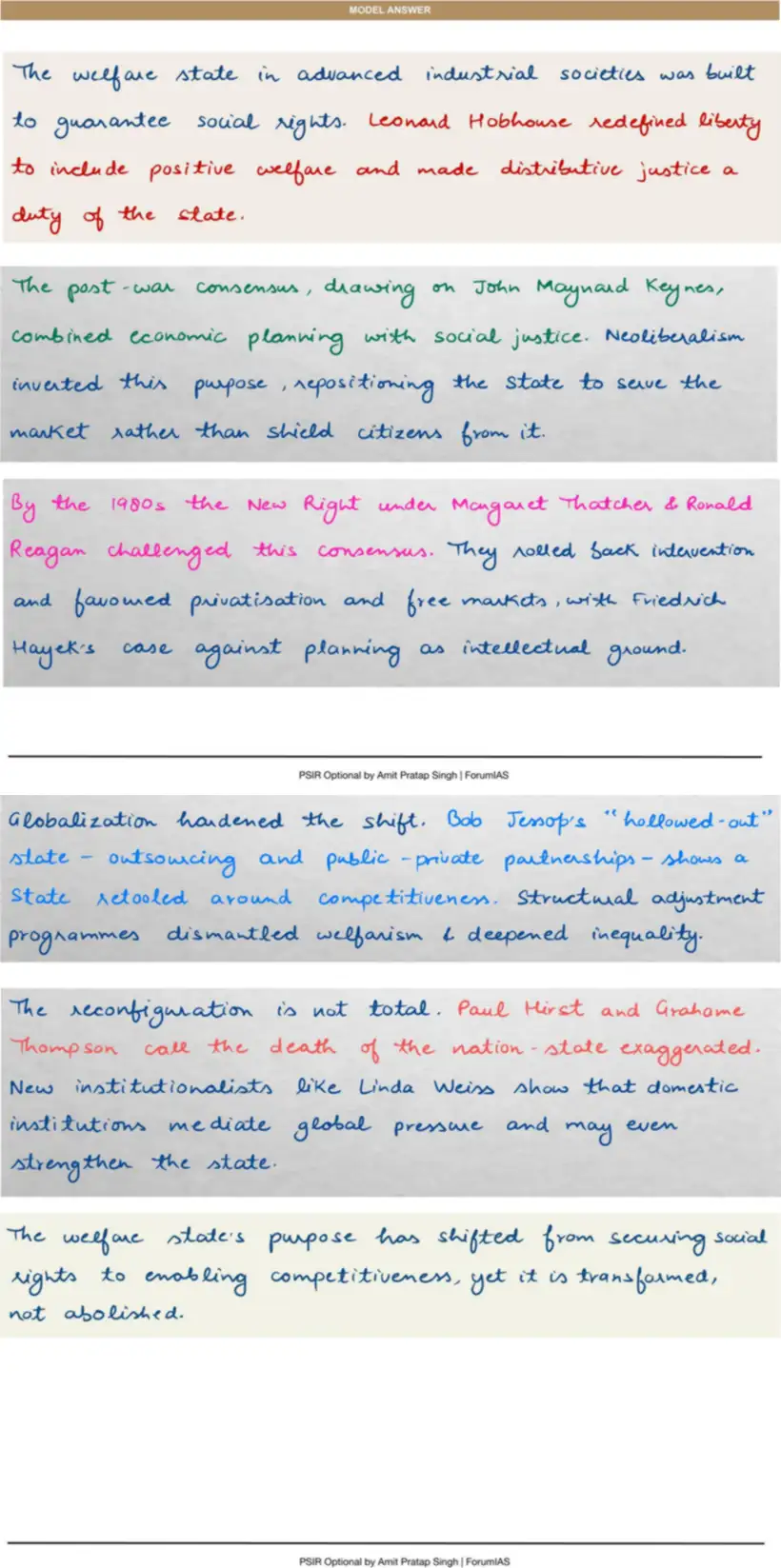
Model answer
Handwritten, in the form it would be written in the examination hall.
Also asked on this head
Principal Organs of the Union and State Government — 17 questions in the Vault.
- Critically comment on the shifts in the functioning of the Indian Parliament in the last two decades.
- Highlight any five constitutional provisions that restrain the powers of the executive, and evaluate their effectiveness in current times.
- Analyse the arguments in favour and against the lateral entry into higher civil services in India.
How this is taught
The same flow snapshot, built for every head of the syllabus, with the answer written in class.
The first session of Foundation 2027 is published in full.
Six programmes across three levels.