
Examine the evolution of the jurisdiction of the Supreme Court of India as a constitutional court.
How the answer moves
The flow snapshot — the routes in, the body, the counter-view and the routes out.
Route 1 1950 founding → five jurisdictions (131 original, 136 appellate/SLP, 143 advisory, 32 writ, 137 review) → constitutional guardian; Art 32 = protector of FRs (Ambedkar, “soul”)
Route 2 SC born as a court of defined jurisdictions → examine the shift towards a constitutional court that guards and shapes the Constitution
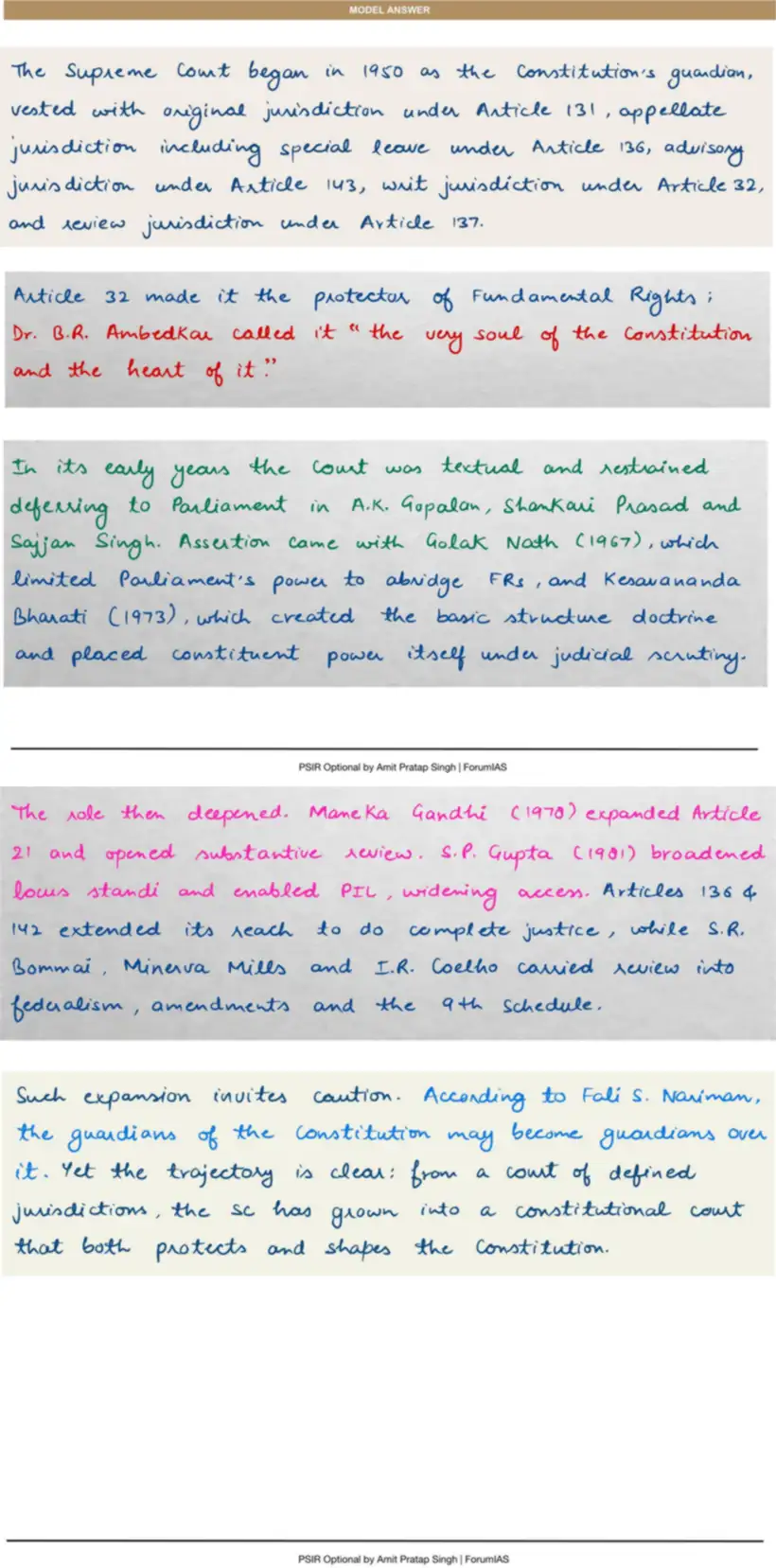
Guardian role + Art 32 / Ambedkar → early restraint (Gopalan, Shankari Prasad, Sajjan Singh) → Golak Nath limits amending power over FRs → Kesavananda basic structure → constituent power scrutinised → Maneka expands Art 21 / substantive review → S.P. Gupta widens locus standi + PIL / access → Arts 136 + 142 / complete justice → Bommai, Minerva Mills, Coelho → review over federalism, amendments, the Ninth Schedule
Nariman: guardians of the Constitution → guardians over it (basic-structure expansion risks overreach)
Route 1 From enumerated jurisdictions → a constitutional court that both protects and shapes the Constitution
Route 2 Evolution as a widening of jurisdiction, not a break from text → the guardian became a shaper while staying anchored in the Constitution
Model answer
Handwritten, in the form it would be written in the examination hall.
Also asked on this head
Principal Organs of the Union and State Government — 17 questions in the Vault.
- Critically comment on the shifts in the functioning of the Indian Parliament in the last two decades.
- Highlight any five constitutional provisions that restrain the powers of the executive, and evaluate their effectiveness in current times.
- Analyse the arguments in favour and against the lateral entry into higher civil services in India.
How this is taught
The same flow snapshot, built for every head of the syllabus, with the answer written in class.
The first session of Foundation 2027 is published in full.
Six programmes across three levels.