
Legislative Council is a house without any effective powers. Comment.
How the answer moves
The flow snapshot — the routes in, the body, the counter-view and the routes out.
Route 1 Art 169 (creation/abolition) + Art 171 (composition) → secondary chamber, weaker than even the Rajya Sabha → charge has force, but “without any” overstates
Route 2 Take the claim head-on → test the absolute “without any” → concede weakness on decisive power, deny total powerlessness
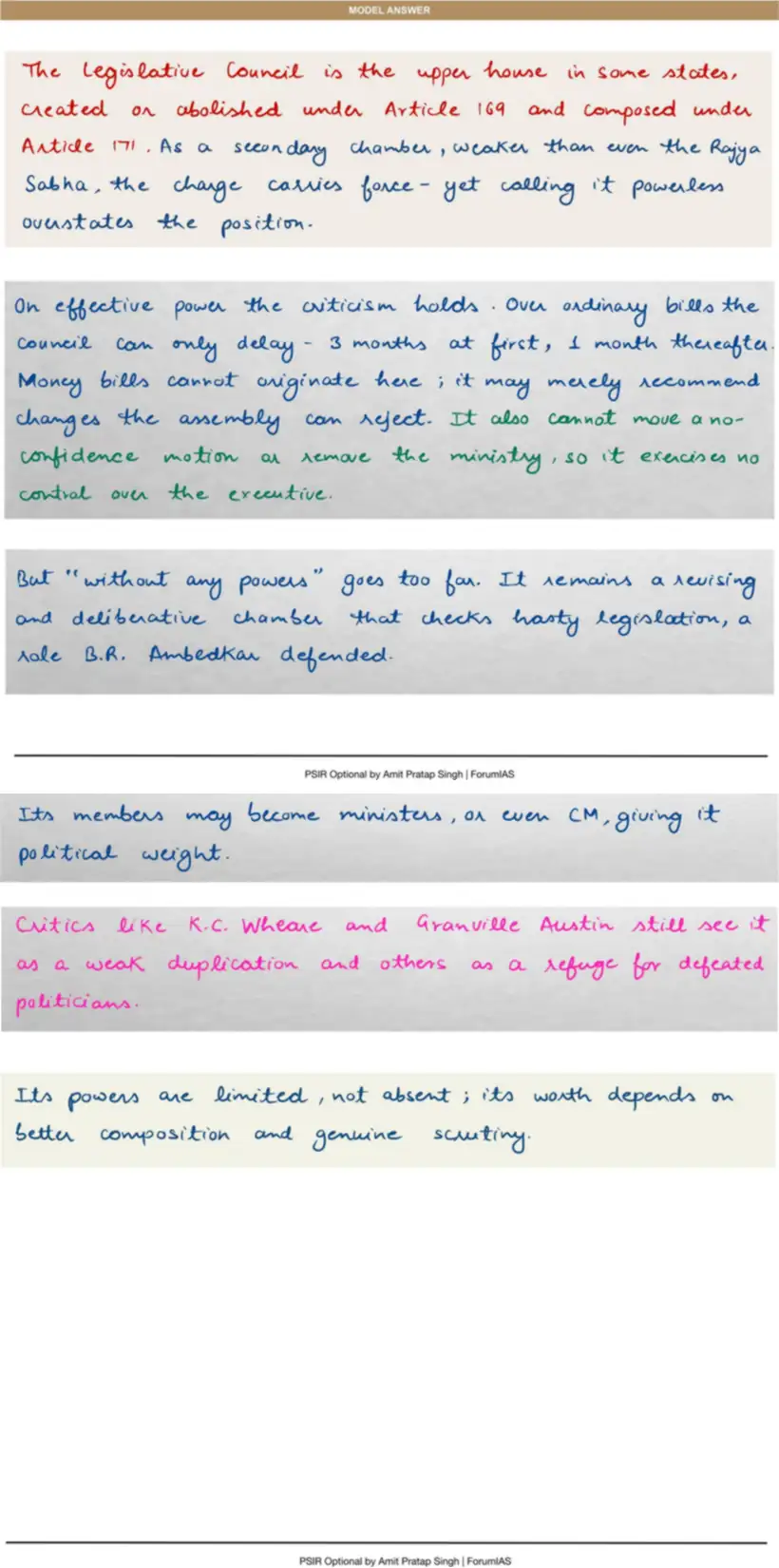
Critique holds → ordinary Bills: delay only (3 months → 1 month, Assembly final say) → Money Bills: cannot originate, only recommend → no no-confidence, no control over executive → but not powerless → revising + deliberative chamber, checks hasty legislation (Ambedkar) → members can be ministers / Chief Minister → political weight
Wheare + Austin: weak duplication → others: a costly refuge for defeated politicians
Route 1 Powers limited, not absent → advisory worth is real → turns on better composition + genuine scrutiny
Route 2 Claim true on decisive power, overstated as a whole → value is deliberative, contingent on reform
Model answer
Handwritten, in the form it would be written in the examination hall.
Also asked on this head
Principal Organs of the Union and State Government — 17 questions in the Vault.
- Critically comment on the shifts in the functioning of the Indian Parliament in the last two decades.
- Highlight any five constitutional provisions that restrain the powers of the executive, and evaluate their effectiveness in current times.
- Analyse the arguments in favour and against the lateral entry into higher civil services in India.
How this is taught
The same flow snapshot, built for every head of the syllabus, with the answer written in class.
The first session of Foundation 2027 is published in full.
Six programmes across three levels.