
Prime Minister’s Office (PMO) has emerged as the most powertul institution in India. Discuss.
How the answer moves
The flow snapshot — the routes in, the body, the counter-view and the routes out.
Route 1 Extra-constitutional, recognised only under the Allocation of Business Rules → PM (political) + Principal Secretary (admin) → “most powerful” claim rests on growth beyond the brief
Route 2 PMO built only to assist the PM → real weight has outgrown that mandate → power is real, but not institutionally supreme
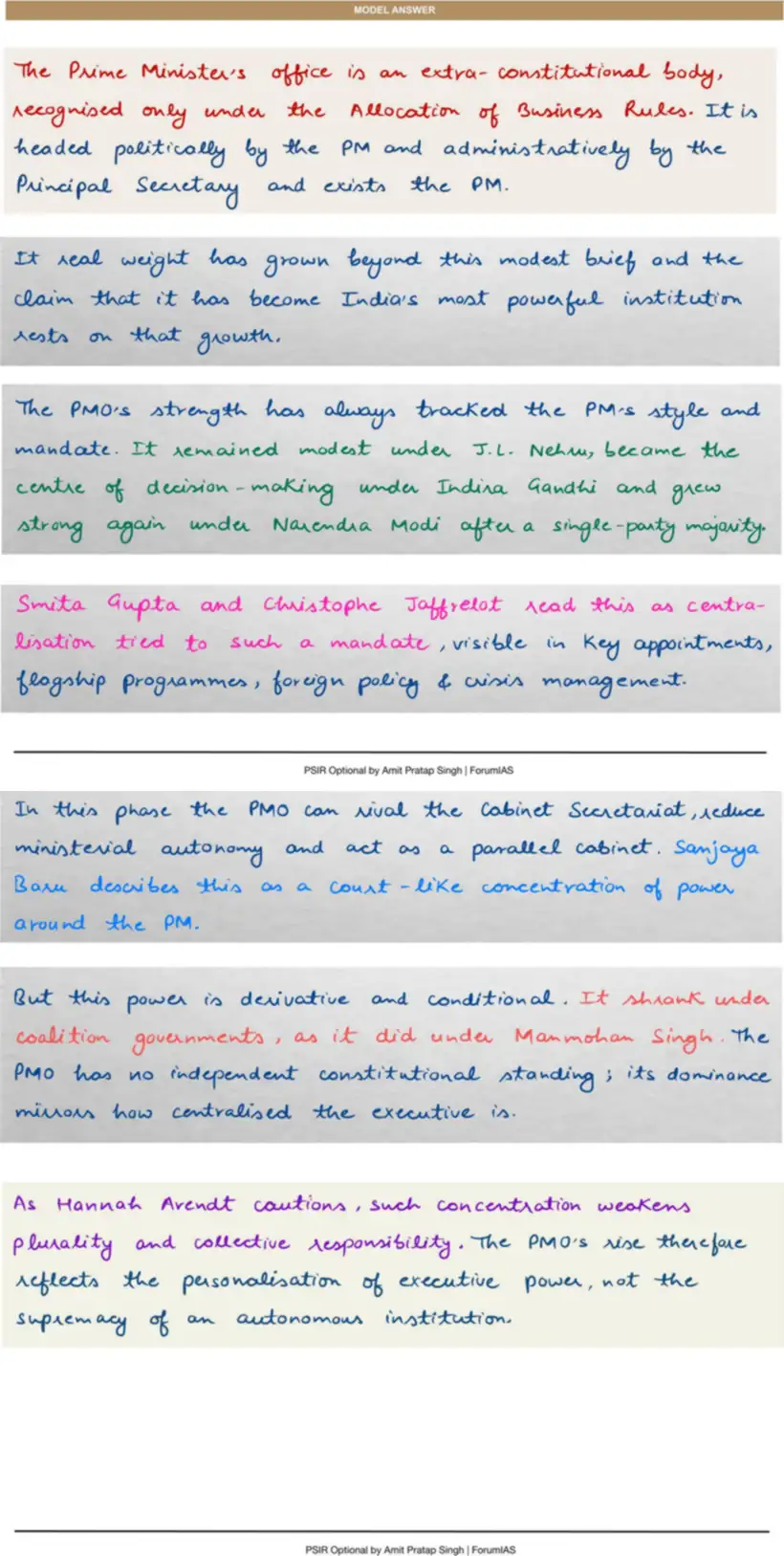
Strength tracks PM’s style/mandate → modest (Nehru) → decision-centre (Indira) → strong again (Modi, single-party majority) → Gupta + Jaffrelot: centralisation tied to mandate → appointments + flagship programmes + foreign policy + crisis management → rivals Cabinet Secretariat + erodes ministerial autonomy + parallel cabinet → Baru: court-like concentration around the PM
Power derivative + conditional → shrank under coalitions (Manmohan Singh) → no independent constitutional standing → dominance only mirrors executive centralisation → Arendt: concentration weakens plurality + collective responsibility
Route 1 PMO’s rise = personalisation / centralisation of executive power, not the supremacy of an autonomous institution
Route 2 Democratic balance needs Cabinet deliberation + transparency + a restored Cabinet Secretariat role
Model answer
Handwritten, in the form it would be written in the examination hall.
Also asked on this head
Principal Organs of the Union and State Government — 17 questions in the Vault.
- Critically comment on the shifts in the functioning of the Indian Parliament in the last two decades.
- Highlight any five constitutional provisions that restrain the powers of the executive, and evaluate their effectiveness in current times.
- Analyse the arguments in favour and against the lateral entry into higher civil services in India.
How this is taught
The same flow snapshot, built for every head of the syllabus, with the answer written in class.
The first session of Foundation 2027 is published in full.
Six programmes across three levels.