
Do you agree that over the years the Supreme Court has become a forum for policy evolution? Justify your answer.
How the answer moves
The flow snapshot — the routes in, the body, the counter-view and the routes out.
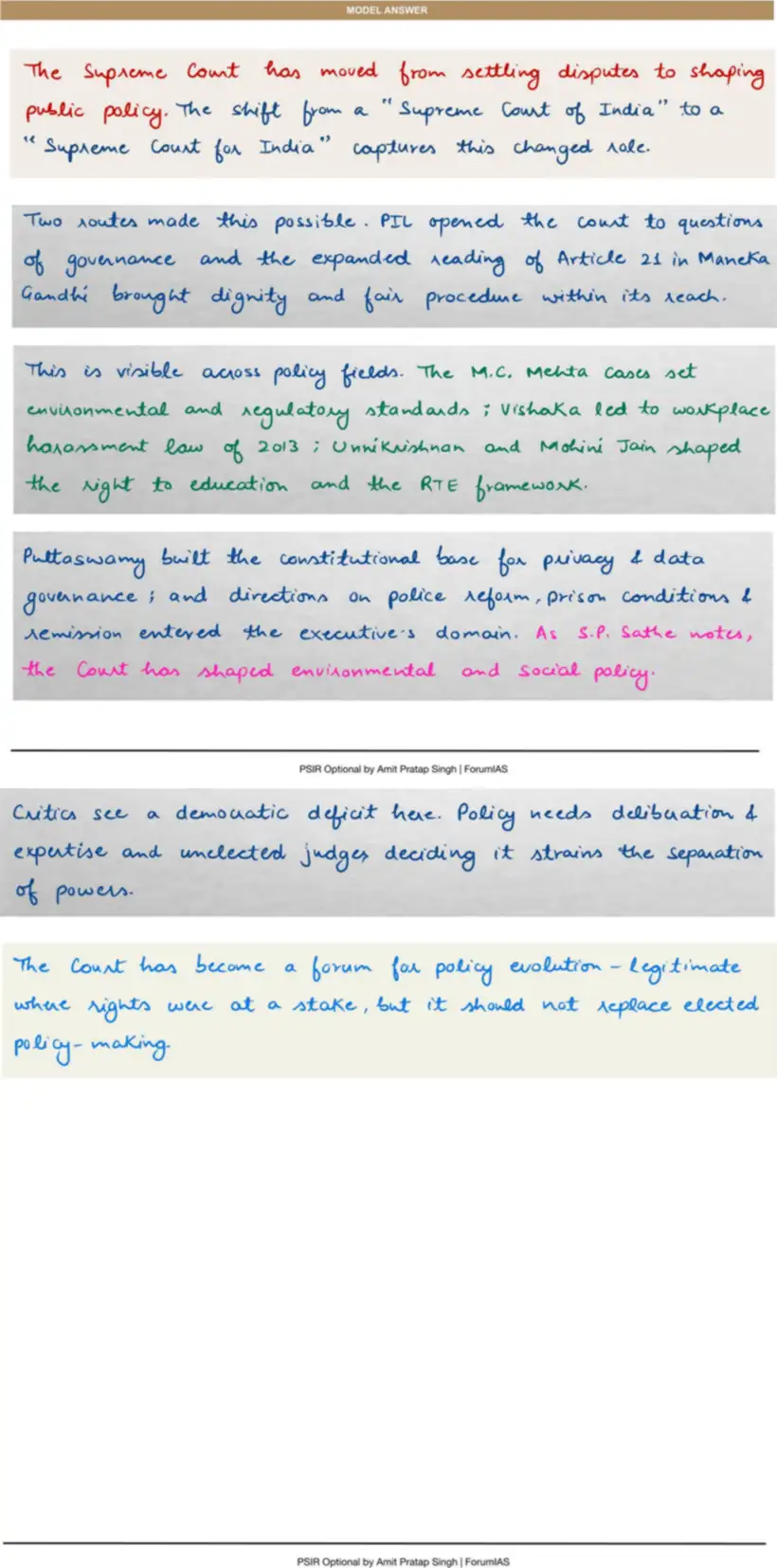
Route 1 Court moved from dispute-settler to policy-shaper → “Supreme Court of India” to “Supreme Court for India”
Route 2 PIL + an expanded Article 21 turned adjudication into governance → a policy forum emerges
PIL opens governance + Maneka Gandhi expands Art 21 (dignity, fair procedure) → M.C. Mehta (environment / regulatory standards) → Vishaka ( → 2013 workplace harassment law) → Unnikrishnan / Mohini Jain ( → RTE) → Puttaswamy ( → privacy / data governance) → criminal-justice directions (police, prisons, remission) into the executive domain → S.P. Sathe: courts shaped environmental + social policy
Democratic deficit → policy needs deliberation + expertise → unelected judges strain the separation of powers
Route 1 Qualified yes: a policy forum, legitimate where rights were at stake
Route 2 Agree, but the Court must not replace elected policy-making
Model answer
Handwritten, in the form it would be written in the examination hall.
Also asked on this head
Principal Organs of the Union and State Government — 17 questions in the Vault.
- Critically comment on the shifts in the functioning of the Indian Parliament in the last two decades.
- Highlight any five constitutional provisions that restrain the powers of the executive, and evaluate their effectiveness in current times.
- Analyse the arguments in favour and against the lateral entry into higher civil services in India.
How this is taught
The same flow snapshot, built for every head of the syllabus, with the answer written in class.
The first session of Foundation 2027 is published in full.
Six programmes across three levels.