
Judiciary has acquired the role of both, a legislature and an executive in recent years. Examine with suitable examples.
How the answer moves
The flow snapshot — the routes in, the body, the counter-view and the routes out.
Route 1 Core judicial role = adjudication + constitutional review, not law-making/administration → but Arts 32, 226, 136, 142 + PIL pull courts into both → filling gaps or replacing elected branches?
Route 2 Claim partly real → judiciary has stepped into legislative + executive space → where does activism end and overreach begin?
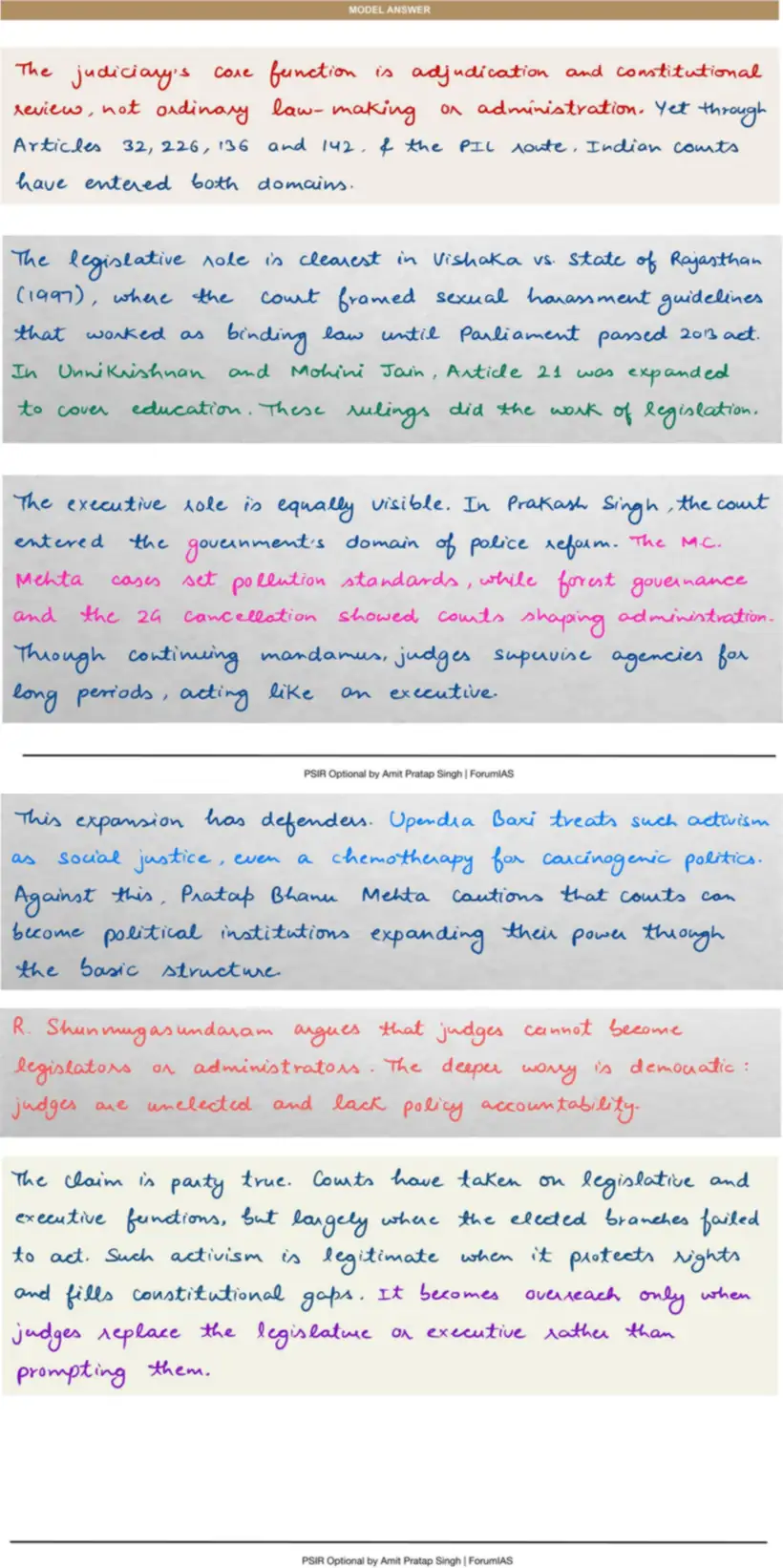
Legislature side: Vishaka guidelines = binding law till the 2013 Act → Article 142 directions (khap panchayats, firecrackers) read like statutes → Unnikrishnan / Mohini Jain expand Art 21 to education → courts doing legislation’s work. Executive side: Prakash Singh enters police-reform domain → M.C. Mehta pollution standards, forest governance, 2G → continuing mandamus = sustained supervision, court acts like executive
Baxi defends activism as social justice (chemotherapy of carcinogenic politics) vs Pratap Bhanu Mehta (courts as political institutions, basic structure expands power) + Shunmugasundaram (judges ≠ legislators/administrators) → democratic deficit: unelected, no policy accountability
Route 1 Claim partly true → courts entered both domains, but mainly where elected branches defaulted
Route 2 Activism legitimate when it protects rights / fills gaps → overreach when judges replace, not prompt, legislature/executive
Model answer
Handwritten, in the form it would be written in the examination hall.
Also asked on this head
Principal Organs of the Union and State Government — 17 questions in the Vault.
- Critically comment on the shifts in the functioning of the Indian Parliament in the last two decades.
- Highlight any five constitutional provisions that restrain the powers of the executive, and evaluate their effectiveness in current times.
- Analyse the arguments in favour and against the lateral entry into higher civil services in India.
How this is taught
The same flow snapshot, built for every head of the syllabus, with the answer written in class.
The first session of Foundation 2027 is published in full.
Six programmes across three levels.