
Parliamentary committees are indispensable to the legislative process. It provides for the opportunity for cross-pollination between the two chambers of the Parliament. Discuss.
How the answer moves
The flow snapshot — the routes in, the body, the counter-view and the routes out.
Route 1 Wilson: committee-rooms = “Congress at work” → full House short on time, hit by disruption → detailed work shifts to committees
Route 2 Legislative load too heavy for the floor → Articles 105 & 118 empower committees → real scrutiny moves off the House floor
Constitutional base (Art 105/118) → depth via DRSCs (post-1989): technical scrutiny + expert input + non-partisan → financial control: PAC (Morris-Jones), Estimates, CPU guard public money → Chakshu Roy: identify issues, suggest solutions, flag gaps → reports aid interpretation (Kalpana Mehta) → cross-pollination: joint + departmental committees seat both Houses together → Lok Sabha ↔ Rajya Sabha shape a Bill together
Referrals collapse 71% (15th LS) → 16% (17th LS) → farm laws bypass scrutiny → short tenure, weak attendance, non-binding reports → Pratap Bhanu Mehta: weak committees feed executive centralisation
Route 1 NCRWC: send all major Bills to DRSCs → restored committees secure law quality + inter-chamber collaboration
Route 2 Indispensability real but neglected in practice → revival = better laws + genuine cross-pollination between the Houses
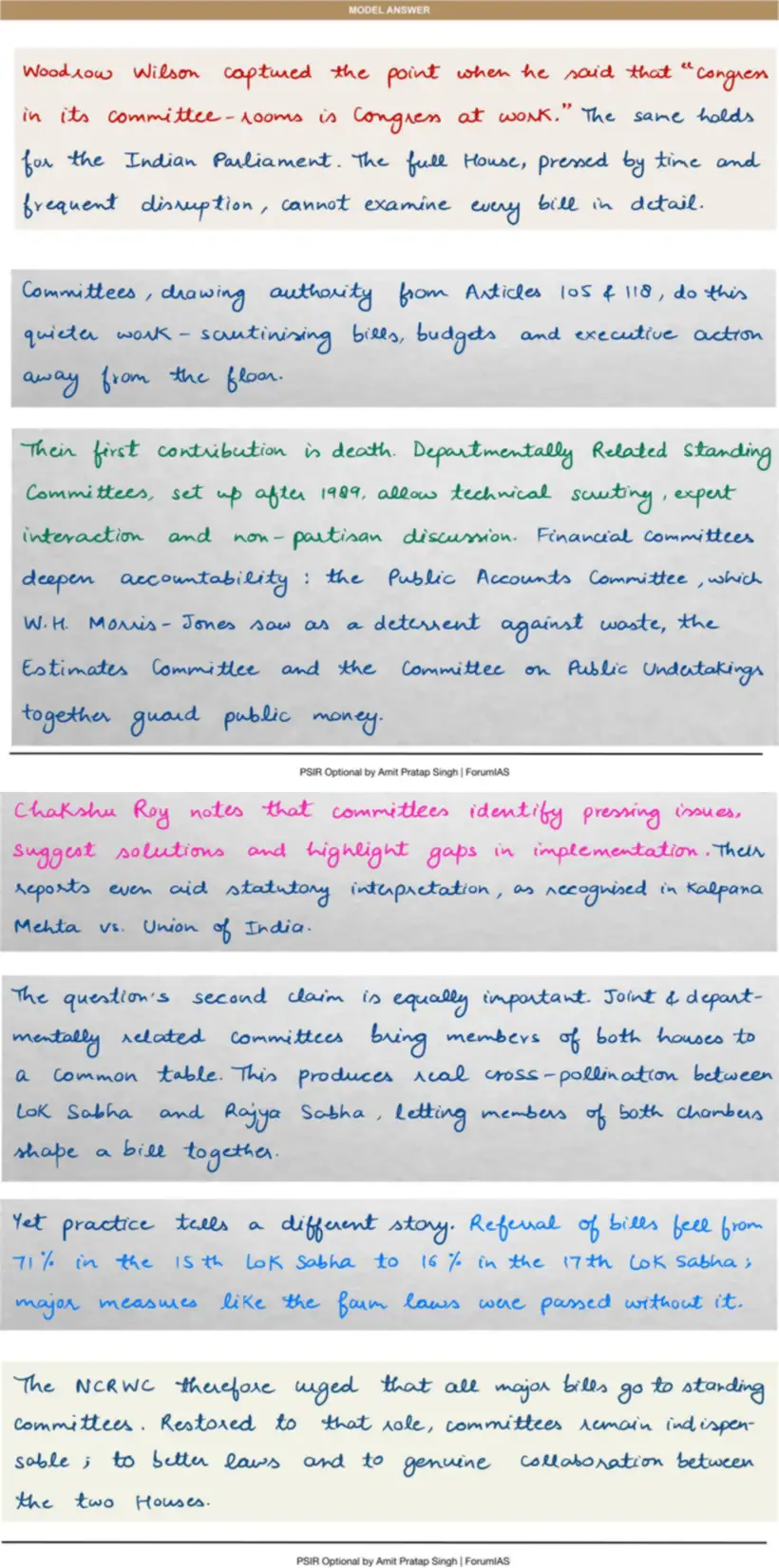
Model answer
Handwritten, in the form it would be written in the examination hall.
Also asked on this head
Principal Organs of the Union and State Government — 17 questions in the Vault.
- Critically comment on the shifts in the functioning of the Indian Parliament in the last two decades.
- Highlight any five constitutional provisions that restrain the powers of the executive, and evaluate their effectiveness in current times.
- Analyse the arguments in favour and against the lateral entry into higher civil services in India.
How this is taught
The same flow snapshot, built for every head of the syllabus, with the answer written in class.
The first session of Foundation 2027 is published in full.
Six programmes across three levels.