
Examine the constitutional provisions and nature of advisory jurisdiction of Supreme Court of India. Evaluate your answer with relevant examples.
How the answer moves
The flow snapshot — the routes in, the body, the counter-view and the routes out.
Route 1 Art 143 = source of advisory jurisdiction → origin in Sec 213(1), GoI Act 1935 / Federal Court → a consultative, non-binding power
Route 2 Executive seeks the Court’s opinion on a constitutional question before a dispute arises → located in Art 143(1)–(2)
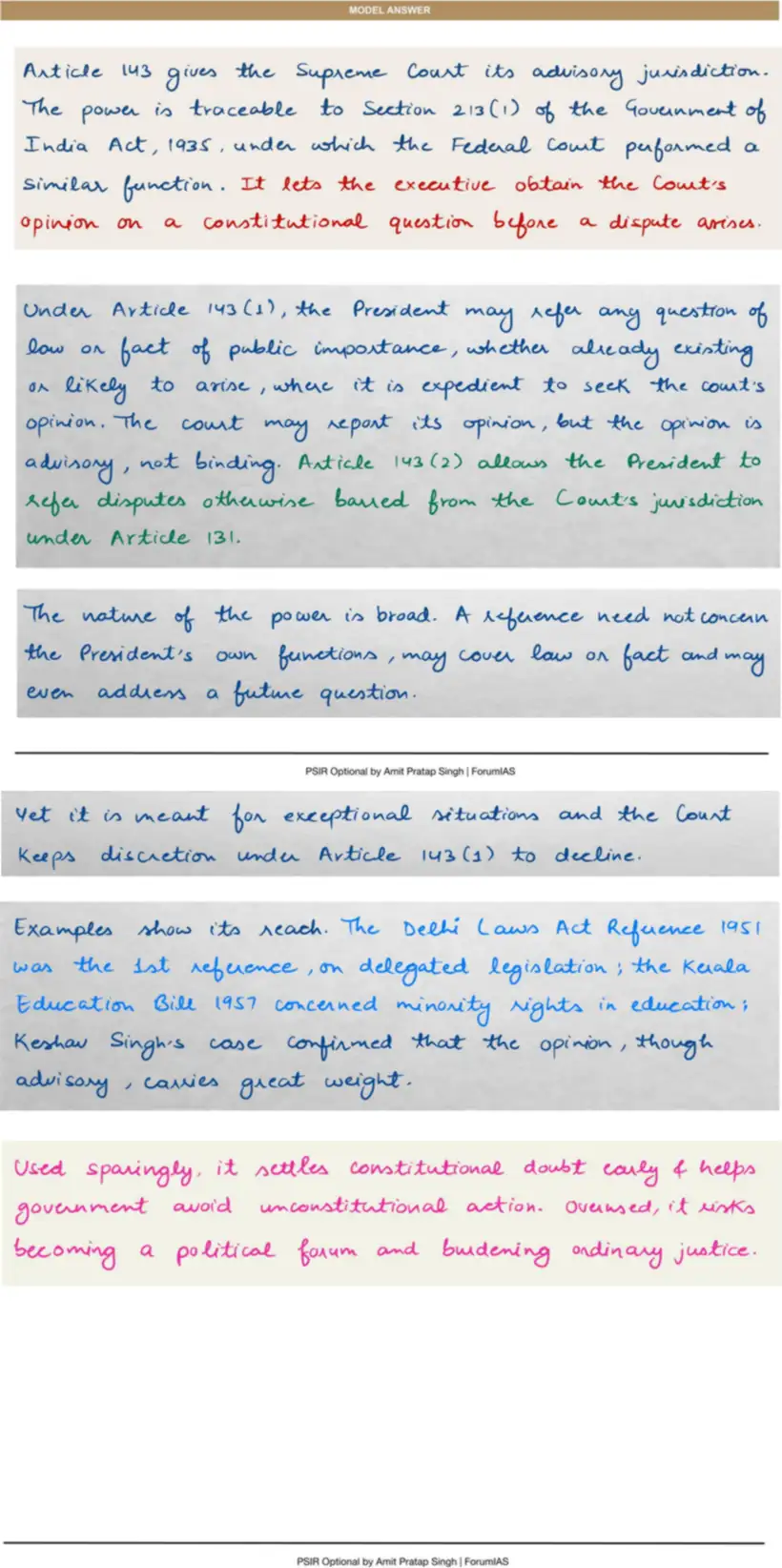
143(1): question of law/fact, public importance, existing or likely → Court may report → opinion advisory, not binding → 143(2): disputes barred from Art 131 → broad: not limited to President’s functions, covers law or fact, even future questions → meant for exceptional cases → Court’s discretion under 143(1) to decline → Delhi Laws Act Reference 1951 (first; delegated legislation) → Kerala Education Bill 1957 (minority rights, education) → Keshav Singh (advisory but great weight)
Value vs misuse → sparing use removes doubt early + prevents unconstitutional action ↔ overuse → becomes a political forum + burdens ordinary justice
Route 1 Legitimate when used sparingly → settles constitutional doubt early, keeps government within the Constitution
Route 2 A consultative aid, not a political shortcut → discretion + restraint preserve its value
Model answer
Handwritten, in the form it would be written in the examination hall.
Also asked on this head
Principal Organs of the Union and State Government — 17 questions in the Vault.
- Critically comment on the shifts in the functioning of the Indian Parliament in the last two decades.
- Highlight any five constitutional provisions that restrain the powers of the executive, and evaluate their effectiveness in current times.
- Analyse the arguments in favour and against the lateral entry into higher civil services in India.
How this is taught
The same flow snapshot, built for every head of the syllabus, with the answer written in class.
The first session of Foundation 2027 is published in full.
Six programmes across three levels.