


- Prelims Test Series (PTS) for Prelims 2027 starts 11th Oct. 2026 Click Here to know more →
- [Pre-order] Ethics Redbook 3rd Edition: Delivery starts from 10th October onwards Click Here to Read More →
- 21 Sept. | Forum Residential Coaching (FRC) for UPSC preparation Click Here to know more →
- 21 Sept. | GS Advance Program (GSAP) for UPSC 2027 Mains starts from 10th Oct. Click Here to Read More →
Download PDF Daily 7 PM Initiative
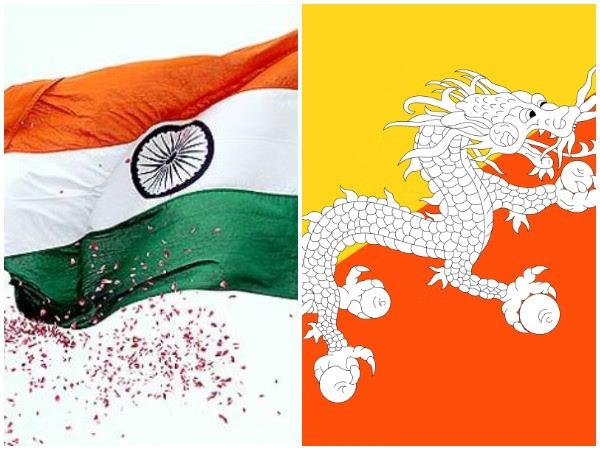
PM Narendra Modi is on a visit to Bhutan. India-Bhutan relations are marked by exemplary friendship, trust, and multi-sectoral cooperation, but also face complexities arising from strategic, economic, and geopolitical challenges. The relationship is India’s one of the most successful partnerships – that thrives despite vast asymmetry in size & significant changes in the regional environment.
| Table of Content |
| Introduction Significance of India-Bhutan Bilateral Relations Challenges in India-Bhutan Bilateral Relations Various areas of Cooperation between India & Bhutan Way Forward |
Introduction:
- Relationship with Bhutan is cornerstone of India’s Neighbourhood First Policy.
- The relationship is characterized by deep trust, shared security interests, and extensive developmental cooperation. It is often described as a special relationship that has withstood geopolitical challenges.
- The relationship is built on a legacy of mutual respect and is underpinned by key treaties:
- Treaty of Peace and Friendship (1949): This was the original foundation, establishing close ties.
- Revised Treaty of Peace and Friendship (2007): The treaty was revised to reflect Bhutan’s sovereignty and transition to a constitutional monarchy. While preserving the spirit of close cooperation, the revised treaty grants Bhutan full authority over its foreign policy, while New Delhi remains committed to assisting Bhutan’s security and development.
Significance of India-Bhutan Bilateral Relations:
| For India |
|
| For Bhutan |
|
Challenges in India-Bhutan Bilateral Relations:
- Bhutan-China Border Talks: Bhutan is actively engaged in border negotiations with China, particularly concerning the disputed areas in the north and the crucial Doklam Plateau in the west. Any settlement reached between Bhutan and China has profound implications for India, especially for the security of its Siliguri Corridor (the “Chicken’s Neck”).
- Hydropower Concerns: While hydropower is a cornerstone of bilateral cooperation, Bhutanese critics sometimes see project terms as too favorable to India, leading to public dissent and questions around equity and sustainability. Delays and cost overruns in hydropower projects contribute to discontent in Bhutan.
- Trade Diversification & Economic Diversification:
- Bhutan faces a persistent trade deficit, importing much more from India than it exports, despite preferential trade agreements.
- Bhutan is keen to diversify its economy into non-hydro sectors like high-end tourism, IT, and sustainable industries.
- Despite the free trade agreement, Bhutanese businesses sometimes face non-tariff barriers or bureaucratic hurdles when trying to access the Indian market.
- Connectivity & Infrastructure Gaps:
- Road, rail, and transport links between India and Bhutan remain limited, hampering further economic and strategic integration.
- Bhutan’s reservations about joining the BBIN Motor Vehicles Agreement due to sustainability and environmental concerns have slowed regional connectivity initiatives.
- The “Big Brother” Syndrome: Due to India’s overwhelming size and historical role as protector, there is a persistent public sentiment (though small) in Bhutan that views India as overly dominant or a “Big Brother.”
- Environmental & Social Sensitivities: Bhutan’s focus on Gross National Happiness and environmental preservation sometimes clashes with India’s infrastructure-led approach (e.g., highways, hydropower, BBIN MVA). There are concerns about the potential social impacts of rapid integration, such as migration and cultural change.
- Border Management & Security: While the 699 km India-Bhutan border is largely peaceful, incidents of illegal crossings, militant hideouts, and smuggling necessitate close security cooperation.
Various areas of Cooperation between India & Bhutan:
- Hydropower Cooperation (Economic Engine): This is the single most important economic aspect of the relationship and a key driver of Bhutan’s national revenue.
- “Win-Win” Model: India funds, constructs, and operates major hydroelectric projects in Bhutan. India then purchases the surplus electricity at preferential rates. This arrangement provides Bhutan with massive revenue ( accounting for over 25% of its GDP) and provides India with clean, renewable energy.
- Projects: Key projects include Chukha, Tala, Kurichhu, and the large Punatsangchhu Hydroelectric Projects (I and II), which are the result of deep technical and financial collaboration.
- Trade & Economic Cooperation:
- Duty-Free Access: Bhutan enjoys free trade access to the Indian market for most of its exports.
- Development Assistance: India is Bhutan’s largest development partner. The Government of India provides significant financial grants and support for Bhutan’s Five-Year Plans, funding critical sectors like education, health, and infrastructure development.
- Currency Stability: The Indian Rupee (INR) is fully convertible with the Bhutanese Ngultrum (BTN), and India extends currency swap arrangements to Bhutan, ensuring financial stability during economic fluctuations.
- Security & Strategic Cooperation:
- Border Security: India is responsible for training the Royal Bhutan Army (RBA). The RBA and Indian forces cooperate closely on border management.
- Doklam Standoff (2017): When the Chinese military attempted to build a road on the disputed Doklam plateau (claimed by Bhutan), Indian forces intervened based on the strategic implications for India’s own security (Siliguri Corridor or ‘Chicken’s Neck’). India’s intervention demonstrated its commitment to Bhutan’s territorial integrity.
- Connectivity & Infrastructure: India funds and constructs cross-border roads, border infrastructure (BRO Project DANTAK), bridges, and new cross-border railway lines (Gelephu/Kokrajhar, Samtse/Banarhat).

Source: Times of India - Environmental & Climate Cooperation: Joint conservation projects, such as the Transboundary Manas Conservation Area (TraMCA), and collaboration to keep Bhutan carbon-negative and promote eco-tourism.
- Health Cooperation: Medical aid, initiatives like Indira Gandhi Memorial Hospital, COVID-19 assistance, and support with vaccines/essential medicines highlight the health partnership.
Way Forward:
- Make Economic Partnership More Equitable & Diversified:
- Ensure hydropower and trade agreements address Bhutan’s concerns on dependency, revenue sharing, and sector diversification (tourism, digital economy, agriculture).
- Foster Indian investments into Bhutan’s non-hydro sectors—IT, services, manufacturing, health, education—to create jobs and build resilience.
- Offer Bhutan full access to India’s Digital Public Infrastructure (DPI), such as the UPI payment mechanism, to modernize their financial sector.
- Upgrade Connectivity & Infrastructure:
- Accelerate new cross-border railway links (e.g., Gelephu-Kokrajhar, Samtse-Banarhat), border checkposts, and digital integration for seamless trade and transit.
- Enhance road, air, and digital connectivity for North-East India, Bhutan, and regional integration.
- Strengthen Security & Strategic Coordination:
- Maintain regular security dialogues and border consultations to monitor regional threats, especially China’s moves near the Doklam plateau.
- Intensify cooperation in border management, anti-terrorism, intelligence sharing, and disaster response.
- Promote Sustainable Development & Environmental Harmony: Joint efforts on green energy (hydro, solar, hydrogen), eco-tourism, disaster resilience, and climate adaptation in line with Bhutan’s Gross National Happiness approach.
Conclusion: India-Bhutan relations are a model for good-neighbourly partnerships built on mutual respect, trust, and extensive cross-sectoral cooperation. Continued strategic sensitivity, transparency, and mutual benefit are key to sustaining and strengthening the relationship in the face of evolving regional dynamics.
| UPSC GS-2: International Relations Read More: The Indian Express |



