


ForumIAS LATEST
- Ethics Redbook 3rd Edition: A Textbook That Teaches You How to Think Ethically Click Here to Read More →
- 21 Sept. | Forum Residential Coaching (FRC) for UPSC preparation Click Here to know more →
- 21 Sept. | GS Advance Program (GSAP) for UPSC 2027 Mains starts from 10th Oct. Click Here to Read More →
Child trafficking remains a grim reality in India. According to the latest NCRB data, in 2022, ~3100 children below the age of 18y were rescued from getting trafficked. Between Apr 2024 & Mar 2025, 53000 children were rescued from child labour, trafficking & kidnapping across India. The SC in recent K.P. Kiran Kumar Case has given strict guidelines to prevent such offences, and held that trafficking grossly violates children’s fundamental right to life under Article 21 of the Constitution.
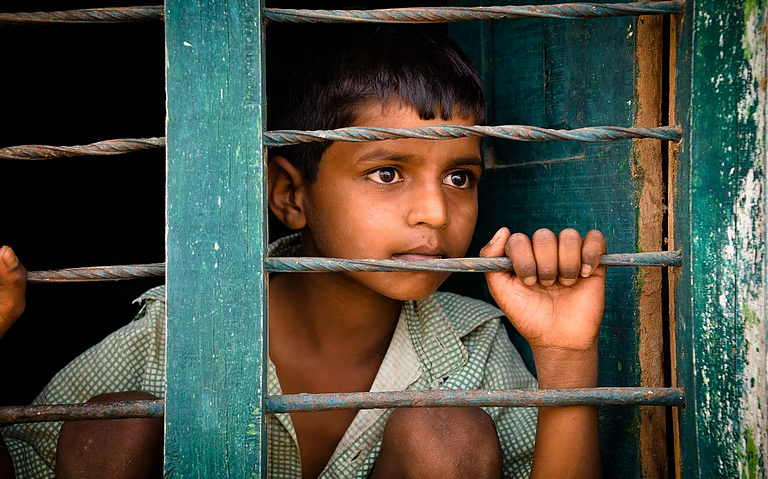
What is child trafficking?
- Palermo Protocol (UN Protocol to Prevent, Suppress & Punish Trafficking in Persons, Especially Women & Children): Defines child trafficking as the “recruitment, transportation, transfer, harbouring or receipt of a child for the purpose of exploitation,” crucially noting that consent is irrelevant for children, meaning it’s trafficking even without force, fraud, or coercion, as a child cannot legally consent to exploitation.
- Section 143 of BNS 2023: Whoever, for the purpose of exploitation, recruits, transports, harbours, transfers, or receives, a person or persons by:
- using threats; or
- using force, or any other form of coercion; or
- by abduction; or
- by practicing fraud, or deception; or
- by abuse of power; or
- by inducement, including the giving or receiving of payments or benefits, in order to achieve the consent of any person having control over the person recruited, transported, harboured, transferred or received, commits the offence of trafficking.
What are the causes of child trafficking?
| Socio-Economic & Cultural Factors |
|
| Governance Failures |
|
| Demand-side Factors |
|
| Other Factors |
|
What are the rights of the children?
- Constitutional Rights:
- Right to Equality (Article 14): Equality before the law and equal protection.
- Right Against Discrimination (Article 15): Prohibits discrimination based on religion, race, caste, sex, or place of birth. Allows special provisions for children.
- Right to Life and Personal Liberty (Article 21): Includes the right to live with dignity, education, and protection.
- Right to Education (Article 21A): Free and compulsory education for children aged 6-14 years.
- Protection Against Exploitation (Articles 23-24):
- Anti-Trafficking (Article 23): Protects children from being trafficked or forced into bonded labor.
- Prohibition of Child Labor (Article 24): No child below the age of 14 can be employed in any factory, mine, or hazardous occupation.
- Right to Early Childhood Care (Article 45): State shall provide early childhood care and education for all children until age 6.
- Legislative Rights:
- Juvenile Justice (Care and Protection of Children) Act, 2015: The Juvenile Justice (JJ) Act, 2015 handles two categories of children:
- Children in Need of Care and Protection (CNCP): Those who are abandoned, orphaned, or victims of abuse. They are entitled to rehabilitation through Child Welfare Committees (CWC).
- Children in Conflict with Law (CCL): Children who commit crimes.
- Right of Children to Free and Compulsory Education (RTE) Act, 2009:
- Ensures free, compulsory education for children aged 6-14.
- Prohibits discrimination, capitation fees, and screening.
- Protection of Children from Sexual Offences (POCSO) Act, 2012:
- A gender-neutral law specifically designed to protect children from sexual abuse, harassment, and pornography.
- It mandates child-friendly courtrooms, prevents the victim from coming face-to-face with the accused, and ensures the child’s identity is kept confidential.
- Child Labour (Prohibition and Regulation) Act, 1986 (Amended in 2016):
- Prohibits employment of children under 14 in all occupations and processes.
- Adolescents (14-18 years) barred from hazardous work.
- Prohibition of Child Marriage Act, 2006:
- Prevents child marriage and protects victims.
- Sets the legal age for marriage at 18 for women and 21 for men.
- Commission for Protection of Child Rights Act, 2005: Establishes National and State Commissions for Child Rights to monitor safeguards.
- Juvenile Justice (Care and Protection of Children) Act, 2015: The Juvenile Justice (JJ) Act, 2015 handles two categories of children:
What have been the Supreme Court’s views on rights of the children?
- Laxmi Kant Pandey vs. Union of India (1984 & onwards): While primarily on inter-country adoption, this series of judgments laid down strict guidelines to prevent the trafficking of children in the guise of adoption, emphasizing “best interests of the child” as the paramount consideration.
- Vishal Jeet vs. Union of India (1990): SC held that trafficking & child prostitution are serious socio-economic problems & hence a preventive & humanistic approach is essential to deal with them.
- MC Mehta vs. State of Tamil Nadu (1996): The Court issued guidelines with the view to prohibiting employment of children in hazardous industries.
- Bachpan Bachao Andolan vs. Union of India (2011): A watershed moment. The Court recognized “the right of children to be free from trafficking and forced labor” as a fundamental right under Article 21. It issued detailed guidelines for:
- Rescue and Rehabilitation: Mandating the creation of a rehabilitation fund for immediate care.
- Railway Protocol: Directing Railways to cooperate in identifying and rescuing trafficked children.
- Central Database: Emphasized the need for a national database of missing children.
What are the various initiatives that have been taken to prevent child trafficking?
- Legal Framework:
- Immoral Traffic (Prevention) Act, 1956 (ITPA): Criminalizes trafficking for commercial sexual exploitation.
- Juvenile Justice (Care and Protection of Children) Act, 2015
- Protection of Children from Sexual Offences (POCSO) Act, 2012
- Child Labour (Prohibition and Regulation) Act, 1986
- Institutional Mechanisms:
- National Commission for Protection of Child Rights (NCPCR) and State Commissions (SCPCRs): Monitor child rights violations and recommend actions.
- Anti-Human Trafficking Units (AHTUs): Specialized police units in districts to investigate trafficking cases. Over 750 AHTUs have been established.
- Child Welfare Committees (CWCs) and Juvenile Justice Boards (JJBs): Statutory bodies for care, protection, and justice for children.
- Integrated Child Protection Scheme (ICPS): A centrally sponsored scheme that supports child protection services, including rehabilitation.
- Childline (1098): This toll-free emergency service is now integrated with the National Emergency Number 112. It acts as the “eyes and ears” for reporting children in distress.
- TrackChild & Khoya-Paya: These portals, now unified under Mission Vatsalya, allow police and citizens to upload data on missing and “sighted” children. The system uses AI to match photos of children found in one state with those reported missing in another.
- GHAR Portal (Go Home and Re-Unite): Specifically designed to track the digital repatriation of children in the Juvenile Justice system, ensuring they are sent back to their home districts and monitored post-restoration.
- Operation AAHT: The Indian Railways is the primary conduit for trafficking syndicates. Operation AAHT, led by the Railway Protection Force (RPF), is the most effective transit-point intervention. Since 2022, this operation has rescued over 2,300 children and apprehended nearly 700 traffickers.
What should be the way forward?
- Strengthen Legal & Policy Frameworks:
- Strict enforcement of existing laws like the Juvenile Justice Act, 2015, POCSO Act, 2012, and Trafficking of Persons (Prevention, Care and Rehabilitation) Act, 2021.
- Fast-track courts for trafficking cases to ensure timely justice and reduce delays.
- National database and tracking system for missing children with real-time coordination between states.
- Enhance Law Enforcement & Border Control:
- Specialized anti-trafficking units in every district with trained personnel (including women officers).
- Strengthen cross-state and cross-border coordination with Nepal, Bangladesh, Myanmar, etc., using technology and intelligence sharing.
- Regular monitoring of trafficking hotspots (railway stations, bus stands, border areas, orphanages, shelter homes).
- Awareness & Community Mobilization:
- Grassroots campaigns in rural/tribal areas to educate parents and children about trafficking tactics (fake job offers, marriage traps, etc.).
- Engage local NGOs, Panchayati Raj institutions, and youth groups as watchdogs.
- Helpline integration (e.g., Childline 1098) with prompt response and rescue mechanisms.
- Rehabilitation & Reintegration: The Supreme Court has mandated the implementation of the BIRD Report (2023) recommendations to prevent re-trafficking:
- Immediate RTE Enrolment: Every rescued child must be enrolled in a school within 15 days of rescue.
- Family Restoration: Rescued children are provided with long-term vocational training, and an adult member of their family is prioritized for a government job to ensure the child isn’t pushed back into the same cycle of poverty.
- Technology & Data-driven Interventions:
- Use of AI and data analytics to identify trafficking patterns and hotspots.
- Digital identity and birth registration for all children to track missing cases.
- Platforms like “TrackChild” to be integrated with police and child protection agencies.
| UPSC GS-2: Social Justice Read More: The Hindu |



