


ForumIAS LATEST
- Prelims Test Series (PTS) for Prelims 2027 starts 11th Oct. 2026 Click Here to know more →
- [Pre-order] Ethics Redbook 3rd Edition: Delivery starts from 10th October onwards Click Here to Read More →
- 21 Sept. | Forum Residential Coaching (FRC) for UPSC preparation Click Here to know more →
- 21 Sept. | GS Advance Program (GSAP) for UPSC 2027 Mains starts from 10th Oct. Click Here to Read More →
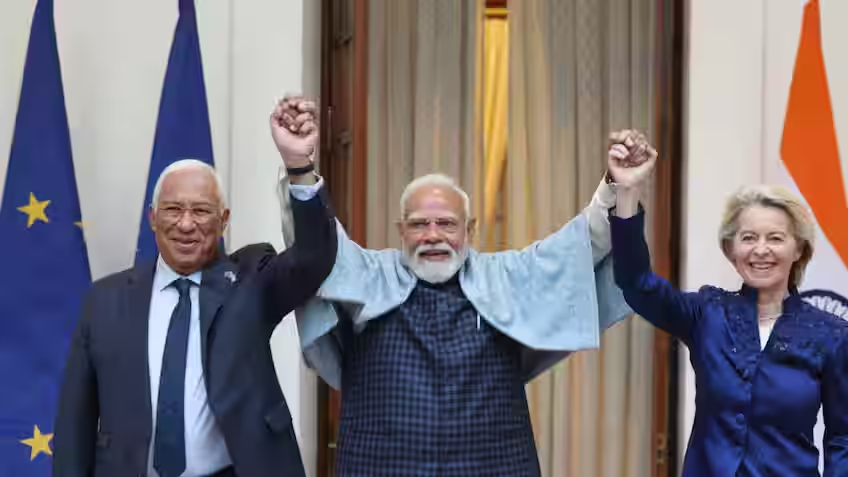
The India-EU Free Trade Agreement (called the Bilateral Trade and Investment Agreement (BTIA)) has been under negotiation since 2007, with talks restarting in 2021 after a long pause. Now after almost 2 decades of negotiation, India & EU have finalized the FTA – which has been referred to as the ‘Mother of All Deals’.
| Table of Content |
| What are the important provisions of India-EU FTA? How does it benefit India? How does it benefit EU? What are the challenges that remain? |
What are the important provisions of India-EU FTA?
- Trade in Goods & Tariffs:
- EU Access for India: The EU will eliminate tariffs on over 99% of Indian exports by value. This is a massive boost for labor-intensive sectors like textiles, apparel, leather, gems and jewellery, and marine products, which will now enter the EU duty-free.
- Indian Access for EU: India will eliminate or reduce tariffs on roughly 92-97% of EU goods.
- Automobiles: Duties on luxury EU cars (above €15,000) will drop from 110% to 10% over five years under a quota system (250,000 vehicles/year).
- Alcohol: Tariffs on premium wines will be cut from 150% to 20%, and spirits to 40%.
- Machinery & Chemicals: Duties of up to 44% on machinery and 22% on chemicals will be mostly eliminated.
- Services and Professional Mobility:
- Market Access: India secured access to 144 EU services sub-sectors (including IT, finance, and education), while India opened 102 sub-sectors to the EU.
- Professional Mobility: The FTA provides a predictable framework for business travelers, intra-corporate transferees, and independent professionals.
- Students: A new framework guarantees post-study work rights (up to 9 months) and eases the path for Indian students to study in the EU.
- Social Security: Both sides agreed to work toward a Social Security Agreement within five years to ensure Indian professionals don’t lose their pension contributions while working in the EU.
- Sustainability and Climate:
- CBAM (Carbon Border Adjustment Mechanism): India secured “Most Favored Nation” (MFN) assurance. While not fully exempt, India will receive technical cooperation and financial assistance (€500 million) to help industries like steel and aluminum reduce their carbon footprint.
- Labor Rights: Both parties committed to core International Labour Organization (ILO) principles, including the abolition of child labor and non-discrimination at work.
- Intellectual Property (IPR) & Technology:
- Traditional Knowledge: The EU has formally recognized India’s Traditional Knowledge Digital Library (TKDL), protecting Indian heritage (like Yoga or Ayurveda) from being patented by foreign firms.
- Tech Cooperation: The deal goes beyond trade to include collaboration on Artificial Intelligence (AI), semiconductors, and clean energy.
- Sensitive Sector Safeguards:
- Agriculture & Dairy: To protect small-scale farmers, India has completely excluded sensitive items like dairy, wheat, rice, and sugar from liberalization.
- Geographical Indications (GIs): A separate agreement is being finalized to protect iconic products (like Darjeeling Tea or Champagne) from imitations.

How does it benefit India?
- Boost to Exports & Economic Growth: India would gain greater and more predictable market access for its competitive export sectors. This includes:
- Textiles and Apparel: Reduced EU tariffs (currently up to 9-12%) would make Indian garments, home textiles, etc., more competitive against rivals like Bangladesh and Vietnam (who already enjoy duty-free access to the EU under Everything But Arms/EBA scheme).
- Agriculture & Processed Foods: Products like basmati rice, mangoes, grapes, spices, and seafood could see higher exports with simplified regulations and recognition of India’s Geographical Indications (GIs).
- Services: Major gains for IT/ITeS, business services, engineering, and R&D. Easier cross-border data flow provisions would be a huge boost.
- Overall, 6% of India’s exports will see tariff reduction – mostly sourced from the labour-intensive sectors – which will help in improving the trade competitiveness of Indian products in the EU market.
- Movement of Skilled Professionals:
- The FTA will help Indian professionals (engineers, IT experts, consultants, nurses, chefs) to get easier & quota-based temporary work visas & permits.
- Mutual Recognition Agreements (MRAs) for professional qualifications (e.g., degrees, certifications for accountants, architects). This would allow Indian professionals to work in the EU without retraining.
- This helps India leverage its demographic dividend, secure high-value remittances, and reduce friction in a traditionally restrictive area for the EU.
- Attracting FDI: The agreement would boost the investor confidence, encouraging EU companies to set up more manufacturing and R&D hubs in India to serve both the Indian and wider Asian markets (“China+1” strategy). This aligns with Make in India and can create jobs and facilitate technology transfer.
- Consumer Benefits: Indian consumers and industries would get access to high-quality EU goods at lower prices due to tariff reductions.
- Technology Transfer & Upgradation: Increased competition and collaboration would push Indian industry to improve quality and innovation. Partnerships in green tech, renewable energy, and digital infrastructure (areas where the EU is a leader) could accelerate India’s sustainable development goals.
- Recognition of Indian Heritage: The EU has officially recognized India’s Traditional Knowledge Digital Library (TKDL). This prevents foreign companies from “biopiracy” – patenting traditional Indian assets like Yoga, Neem, or Ayurveda – and ensures these remain protected Indian intellectual property.
How does it benefit EU?
- Access to a Massive, Fast-Growing Consumer Market: India, with its 1.4 billion people and a rapidly growing middle class, represents one of the world’s last untapped large consumer markets. The EU seeks guaranteed, preferential access for its premium goods -especially in sectors like – Automobile & Auto parts, Wines & Spirits, Cheese & Dairy, Machinery, Chemicals etc.
- Countering China’s Influence (China-Plus-One): The EU has a clear “de-risking” and diversification strategy. Deepening ties with democratic India is a geopolitical imperative to reduce economic over-dependence on China and build a reliable strategic partner in the Indo-Pacific.
- Access to Raw Materials & Intermediates: Reliable access to Indian materials and processed goods (like generic pharmaceutical ingredients, textiles, leather) is crucial for EU industries.
- Boosting EU’s Services & Digital Trade:
- Financial, Legal, and Business Services: EU banks, insurance companies, and professional service firms seek better access to India’s vast and protected services market.
- Digital Trade: New rules protect software source code from mandatory disclosure and establish high standards for data privacy, providing legal certainty for EU tech firms.
- Sustainability Standards: By including chapters on climate (aligned with the Paris Agreement) and labor rights, the EU ensures that its trade with India adheres to the high environmental and ethical standards demanded by European voters.
What are the challenges that remain?
- India’s Demands on Agri & Textiles: India wants greater access for its textiles, garments, and agricultural products (like rice, fruits, shrimp). The EU resists due to sensitive domestic producers (e.g., textile makers in Italy/Portugal, farmers in France/Poland) and non-tariff barriers like stringent Sanitary and Phytosanitary (SPS) measures.
- Non-Tariff Barriers: For Indian exporters, the biggest challenge isn’t the tariff anymore; it’s the Non-Tariff Barriers like:
- CBAM (Carbon Tax): The EU’s Carbon Border Adjustment Mechanism is set to enter its full definitive phase. Even with the FTA, Indian steel and aluminum exporters may still have to pay a “carbon cost” or face 15–22% price cuts to stay competitive unless they drastically green their production.
- EUDR (Deforestation Regulation): New EU rules (phasing in through late 2026) require proof that products like coffee, rubber, and leather did not come from deforested land. This is incredibly difficult for India’s millions of small-scale farmers to document.
- SPS Norms: The EU has some of the world’s strictest Sanitary and Phytosanitary rules. Many Indian agri-products often face rejection due to pesticide residue levels that are acceptable in India but banned in the EU.
- Data Privacy and Digital Friction: While there is alignment between India’s DPDP Act (2023) and the EU’s GDPR, full “data adequacy” has not yet been granted. Without a formal “adequacy status” from the EU, Indian IT firms still face a “compliance tax”—expensive legal and technical hurdles to move and process European data in Indian servers.
- Ratification Hurdles: The agreement must be ratified by the European Parliament. Some EU nations with strong agricultural lobbies (like France) may still raise objections to specific provisions, even though sensitive items like beef and sugar were excluded.
| UPSC GS-3: Indian Economy Read More: The Indian Express |



