


ForumIAS LATEST
- FRC 2027: SFG Residential program | accepting application for Tranche-2 Click Here to know more →
- CSAT Classes for Prelims 2027 by Rishi Bhargav sir starts 16 Nov. at 5 PM Click Here to know more →
- Prelims Sprint classes 2027: Starts 2nd Nov. at 4:30 PM | First class open to all. Click Here to know more →
News: The Union Cabinet approved a ₹14,500 crore Viability Gap Funding (VGF) Scheme to promote Grid-Scale energy storage systems.
About Viability Gap Funding (VGF) Scheme to Promote Grid-Scale Energy Storage Systems
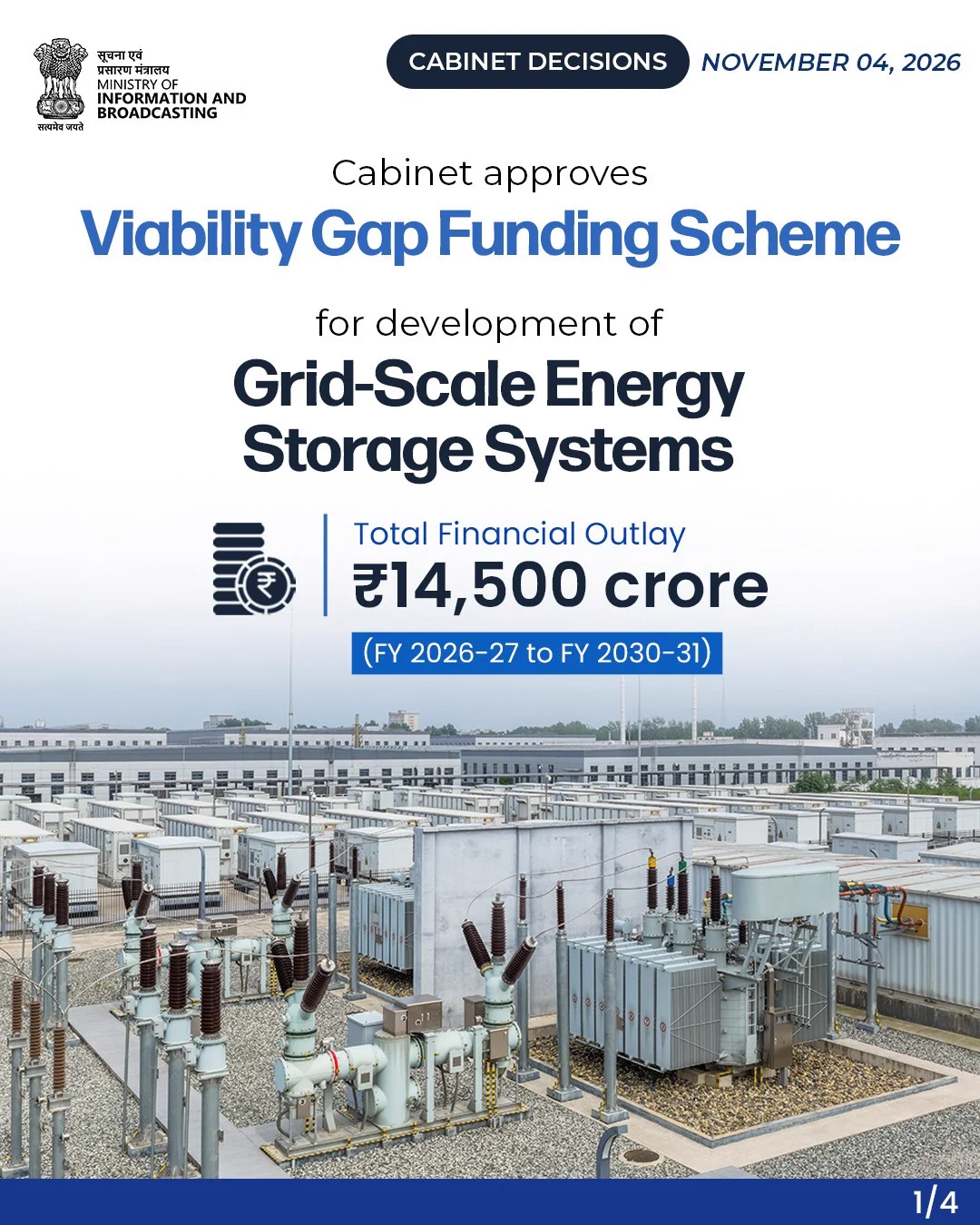
- Viability Gap Funding (VGF) Scheme has been launched to support the development of 92 Gigawatt-hours (GWh) of grid-scale energy storage capacity across the country,
- Aim: The scheme aims to strengthen India’s power infrastructure, facilitate large-scale integration of renewable energy and ensure reliable, affordable and round-the-clock electricity supply.
- Objective: It is to strengthen India’s domestic energy storage manufacturing ecosystem through demand-side financial support and reduce dependence on imported components.
- Nodal ministry: The nodal ministry for the scheme is Ministry of Power
- Time Period: The scheme will be implemented over a period of five financial years, from FY 2026–27 to FY 2030–31.
- Budget: The total budget for the scheme is ₹14,500 crore.
- Eligibility: Public and private sector electricity distribution companies will be eligible for VGF support for battery energy storage and pumped storage projects.
- Energy storage capacity will be allocated through a tariff-based competitive bidding process.
- Projects based on alternative storage technologies will also be implemented by public and private sector entities.
- Features:
- A key feature of the scheme is its focus on strengthening domestic manufacturing.
- Battery Energy Storage System projects will be subject to a minimum Domestic Content Requirement (DCR) of 40 per cent to encourage indigenous production and reduce dependence on imported components.
- The requirement is expected to create opportunities for Indian manufacturers and complement existing government incentives for battery manufacturing.
- Under the initiative, the government will support the development of 60 GWh of Hydro Pumped Storage Projects (PSPs), 30 GWh of Battery Energy Storage Systems (BESS) and 2 GWh of capacity through emerging energy storage technologies.
- The proposed capacity addition will be equivalent to around 170 per cent of India’s existing grid-scale energy storage capacity and contribute towards meeting the country’s estimated requirement of 411 GWh by 2031-32.
- Financial assistance: The financial assistance under the scheme is intended to improve the financial viability of energy storage projects and accelerate the deployment of large-scale storage infrastructure.
- Expected Investment: The projects are expected to attract an estimated investment of ₹97,600 crore.
- A key feature of the scheme is its focus on strengthening domestic manufacturing.
- The initiative would help address the variability of renewable energy generation by enabling better storage and utilisation of electricity generated from renewable sources.



