


- 25 March | The Honest UPSC Talk Nobody Tells You Click Here to see Abhijit Asokan AIR 234 talk →
- 10 March | SFG Folks! This dude got Rank 7 in CSE 2025 with SFG! →
- 10 March | SFG Folks! She failed prelims 3 times. Then cleared the exam in one go! Watch Now! →
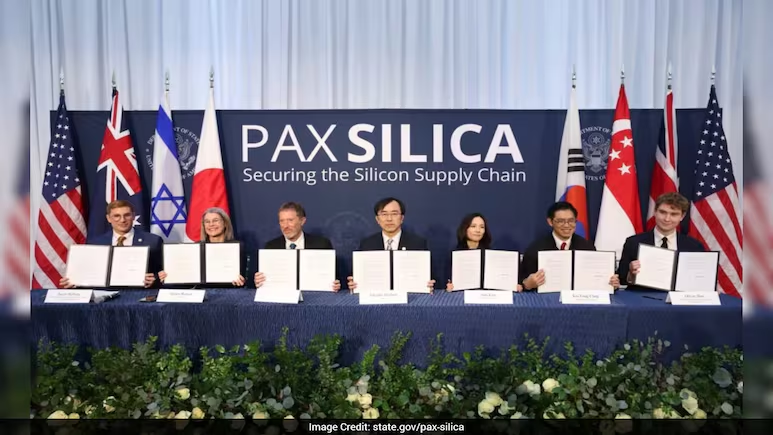
India joins the US-led tech alliance Pax Silica that seeks to build a common supply chain for electronics & critical minerals to withstand disruptions by China. In this regard, let us understand what Pax Silica is & its importance as well as challenges – especially from India’s perspective.
What is Pax Silica?
- Pax Silica is a U.S.-led geopolitical and economic initiative launched in December 2025 aimed at securing the global supply chain for semiconductors and Artificial Intelligence (AI). It is a strategic alliance focused on building secure, resilient, and diversified supply chains for advanced technologies — especially semiconductors, artificial intelligence (AI) infrastructure, critical minerals, and related manufacturing and logistics systems.
- ‘Pax’ in Latin means Peace & ‘Silica’ is a key compound used in chip manufacturing – thus, together they suggest that the supply chain for new technologies should promote peace & prosperity.
- The term implies a potential shift in power from petrostates to “silica states” because of the growing global dependence on high-purity silica sand (especially quartzite) for the 21st-century economy, and the potential for this dependency to shape international relations, similar to how oil (“Pax Petrolia”/”Pax Americana”) did in the 20th century.
- The Pax Silica Declaration noted that the initiative seeks to reduce coercive dependencies, secure global tech/AI supply chains, and build trusted digital infrastructure.
Who are the major participants in Pax Silica?
- Formal Signatories: These countries have formally committed to the Pax Silica Declaration, aligning their export controls, investment screening, and supply chain security protocols:
- United States: The lead architect and convener
- Greece
- Japan: A primary partner in semiconductor materials and advanced manufacturing equipment.
- South Korea: A critical hub for memory chip production
- Singapore: A global leader in semiconductor fabrication and logistics
- Israel: A powerhouse for AI software, defense technology, and specialized R&D
- United Kingdom: A major player in AI research and semiconductor design (ARM)
- Australia: The “resource anchor,” providing critical minerals like lithium and rare earths
- Qatar: Brings significant sovereign wealth and energy resources for data centers
- United Arab Emirates (UAE): Strategic partner in energy, capital (via funds like MGX), and regional tech infrastructure.
- The Netherlands: It is a crucial partner through ASML (the world’s only producer of EUV lithography machines).
- India: India is seen as the vital “alternative manufacturing base” and a source of skilled human capital for the alliance.
- Observers: These entities attend the summits and collaborate on specific projects but have not yet signed the full operational declaration:
- Taiwan: Despite its dominance in advanced chip manufacturing (TSMC), it remains an observer to manage the complex geopolitical sensitivities with China.
- European Union (EU): Participates in discussions but maintains a separate industrial policy, though individual member states (like the Netherlands) engage more directly.
- Canada: Contributing through its critical mineral reserves and AI research hubs.
- OECD: Acts as an advisory guest on global standards and economic impact.
What are the objectives of Pax Silica?
- Secure supply chains: Build resilient supply chains from critical minerals and energy inputs through advanced manufacturing, semiconductors, and AI infrastructure.
- Reduce dependencies: Reduce coercive dependencies and protect materials and capabilities foundational to artificial intelligence.
- Economic cooperation: Create coordinated investment and policy alignment among partner nations.
- Counter non-market practices: Address non-market practices that undermine innovation and fair competition, including overcapacity and dumping.
- Maintaining the “18-Month Moving Gap”: A core strategic objective of Pax Silica is to institutionalize a permanent lead over competitors. The policy allows for the sale of older-generation technology to rivals to fund the R&D for the next generation, ensuring that the members of Pax Silica always remain at least 18 months ahead.
What is the importance of Pax Silica?
- Countering China’s Dominance: China accounts for approximately 69% of global rare-earth mining and nearly 90% of global refining, including a near monopoly over heavy elements essential for high-performance magnets. Pax Silica represents an effort to counter this dominance by creating alternative, trusted supply chains among aligned nations.
- Reducing Critical Supply Chain Vulnerability: Covid pandemic demonstrated the limitations of supply chains that are heavily reliant on a single country. Pax Silica aims to reshore or friend‑shore these supply chains to prevent economic and national‑security risks from over‑reliance on geopolitical rivals.
- Securing Semiconductor Sovereignty: The CHIPS and Science Act is part of this broader “Pax Silica” vision – bringing advanced semiconductor manufacturing (which starts with silicon wafers) back to the U.S. and allied countries.
- Defining the “Silicon Age”: The term itself reflects a historical transition. While Pax Americana was built on oil, steel, and naval dominance, Pax Silica is built on:
- Compute Power: High-end processing is now the “currency” of global influence.
- The Full Stack: Unlike previous chip alliances, it covers the entire lifecycle: from critical minerals (mining/refining) to semiconductors (design/fabs) and AI infrastructure (data centers/energy).
- Trusted Ecosystems: By aligning export controls and investment screening among members, it ensures that sensitive technologies (like EUV lithography machines) do not reach strategic rivals.
- Importance for India:
- Alternative Manufacturing Hub: Pax Silica views India as the primary alternative to China for large-scale manufacturing and a massive source of human talent.
- Domestic Boost: Joining the bloc will accelerate India’s Semiconductor Mission, providing access to advanced “know-how” and coordinated global investments.
What are the challenges of joining Pax Silica for India?
- Dilution of Strategic Autonomy: Pax Silica isn’t just a trade forum; it demands alignment on export controls and investment screening. India has historically resisted being part of “blocs” that dictate who it can trade with (e.g., maintaining ties with Russia or recalibrating with China).
- Policy Sovereignty: As a developing country, India has relatively young semiconductor & AI ecosystems compared with those of other Pax Silica countries. Consequently, India will seek to protect its semiconductor & AI ecosystems by granting domestic firms preferential treatment through subsidies, govt procurement, and calibrated import regulations. But , to be a “trusted partner,” India may have to align its domestic electronics and AI regulations with U.S.-led standards, which could limit its ability to create “India-first” industrial policies or preferential subsidies for local firms.
- Supply Chain Retaliation: Despite its “Semiconductor Mission,” India remains heavily dependent on China for legacy chips, electronic components, and processed minerals. Analysts warn that China could weaponize its licensing conditions on rare-earth magnets (crucial for EVs and electronics) as a response to India joining Pax Silica – similar to what it did in 2025 when China suspended the supply of rare-earth magnets to India, negatively impacting the country’s automobile & electronics industry.
- The “Capability-Leverage” Gap: India was initially left out of the inaugural Pax Silica summit because it lacked “indispensable” technology. Unlike Taiwan (fabrication) or the Netherlands (machinery), India is currently seen as a “useful participant” (for talent and market) rather than a “critical player.” India’s AI & semiconductor ecosystems are also well behind those of Pax Silica countries.
- The Expectation Gap: The member countries of Pax Silica, in addition to their technological strengths, are US allies & high income countries. If India decides to join the Pax Silica, it will be the first developing country & also the first non-US ally to join the initiative. This may create an ‘expectation gap’ between India & the other members of Pax Silica.
- Digital Sovereignty: The Digital Personal Data Protection (DPDP) Act mandates that critical citizen data stay in India. However, Pax Silica encourages seamless data flows between “trusted partners.”.
What can be the way forward?
- Build Domestic Capability:
Upstream Raw Material Security - Map and develop domestic quartz/silica sand resources (e.g., in Rajasthan, Tamil Nadu, Karnataka) with high purity, while establishing strategic stockpiles.
- Invest in beneficiation and purification technologies to upgrade low-grade silica, reducing import dependency.
Midstream Manufacturing Push - Scale up polysilicon and wafer production (for solar and electronics) through PLI-like incentives, joint ventures with tech leaders, and low-cost financing.
- Establish specialized silicon industrial parks with reliable power, water, and logistics – critical for energy-intensive silicon refining.
Downstream Integration - Become a global hub in solar module assembly and advance into high-value semiconductor fabrication (leveraging the India Semiconductor Mission).
- Focus not just on chips but on compound semiconductors (GaN, SiC) for EVs, defense, and telecom.
- “China+1” with Indian Advantage: Position India as a reliable alternative in the Friendshoring/China+1 strategies of the US, EU, Japan, and Taiwan. Use free-trade agreements (e.g., with Taiwan, Australia) to secure technology transfer and materials access.
- Strategic Alliances:
- Join mini-lateral initiatives like the Mineral Security Partnership (MSP) to access global critical minerals (including high-purity silica resources).
- Deepen collaboration with Quad on supply chain resilience, R&D in advanced materials, and securing seabed/mining rights.
- Invest in R&D and Skilling for Next-Gen Technologies:
- Fund research into silicon recycling/recovery from PV panels and e-waste, and alternative substrates (e.g., perovskite-silicon tandem cells).
- Create specialized training programs in materials science, semiconductor process engineering, and advanced manufacturing via partnerships with IITs, global universities, and industry.
- Strategic Autonomy with Alignment: In order to secure its strategic autonomy, India needs to maintain ties with both Western “Pax Silica” blocs and resource-supplying Global South nations, avoiding over-dependence on any one camp.
- Diplomatic Leverage: Use India’s market size and strategic location to negotiate tech transfers (e.g., from Taiwan, Japan) and attract FDI in silicon-based industries.
Conclusion: India should look forward to transform itself from a silicon & high tech consumer to a producer and innovator. This requires combining – Industrial policy (like the China model), Global partnerships (like Japan’s resource diplomacy) & Tech leapfrogging (like Taiwan’s semiconductor focus). By doing this, India will establish itself as a key node in the resilient, diversified global silicon economy while boosting energy security, high-tech employment, and geopolitical influence.
| UPSC GS-2: International Relations Read More: The Hindu |





